Skip to the cabinet
← Interactive cabinet

COMPLETE STATIC EDITION

Seed & Cone Cabinet

Eight trees · sixteen form studies · eight supplementary sections · twelve trait plates.

Original botanical illustrations. No collected Bryce specimens, scans or field measurements. Shape, color, scale count and interior layout are schematic. All illustrations are enlarged independently.

DRAWER 01 · Pinaceae

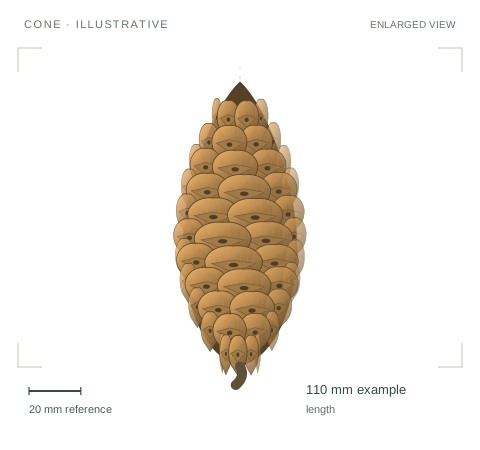
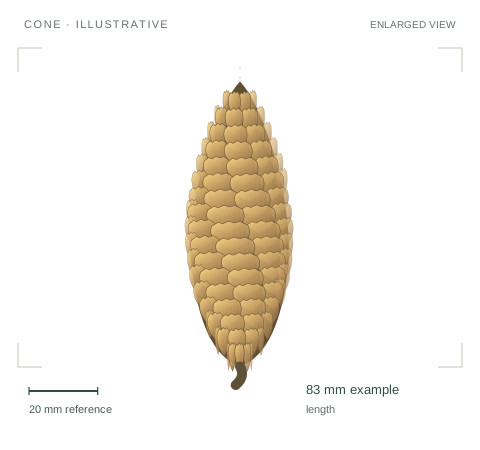
Ponderosa pine

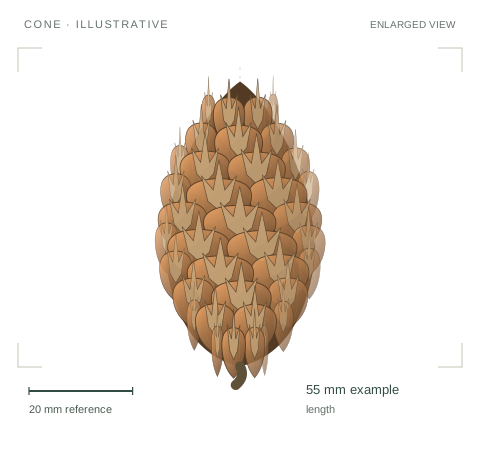
Raised woody scales, often with a short prickle.
A broad cone with robust scale faces. The small central point varies; it is not equally sharp on every scale.
Pinus ponderosa

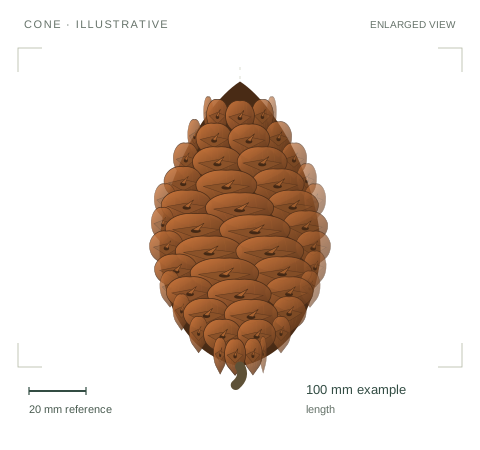
Cone length: 50–150 mm. Species-wide range; not a Bryce population measurement.
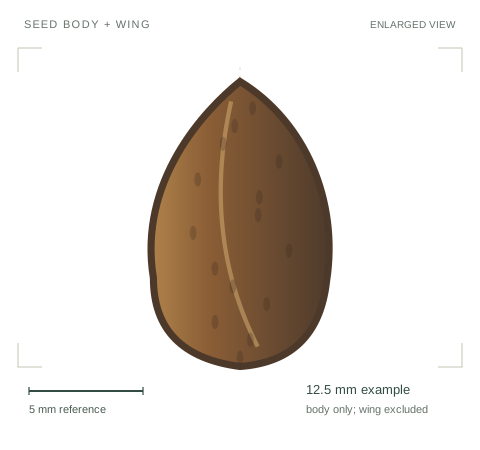
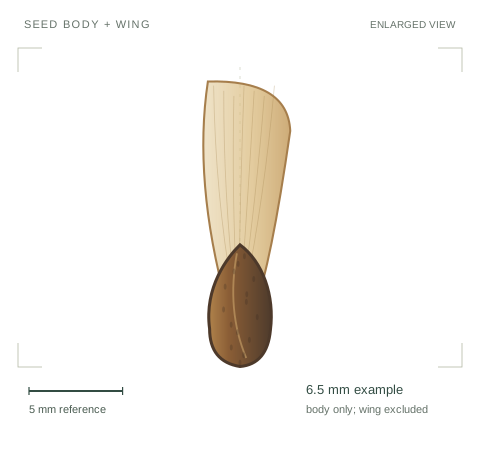
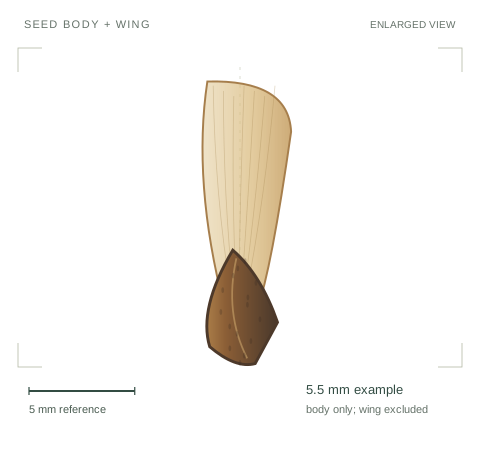
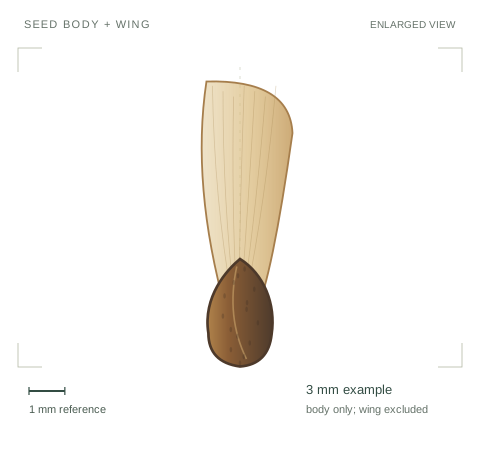
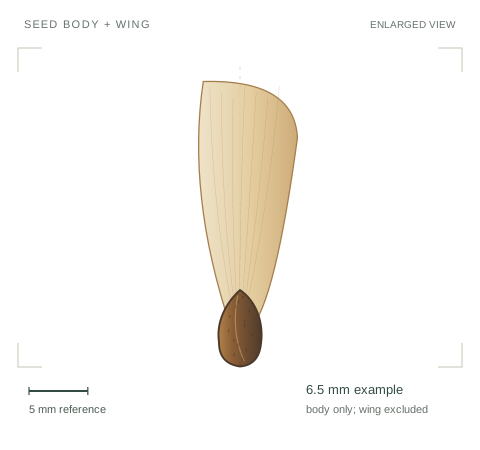
Seed body: 4–9 mm. Seed body; occasional 3 mm bodies also reported.
15–25 mm wing. Cone source · Seed source

Ponderosa pine cone: Raised woody scales, often with a short prickle.
Cone formOpen SVG ↗
Ponderosa pine seed: Small body, long wing
Seed and wingOpen SVG ↗
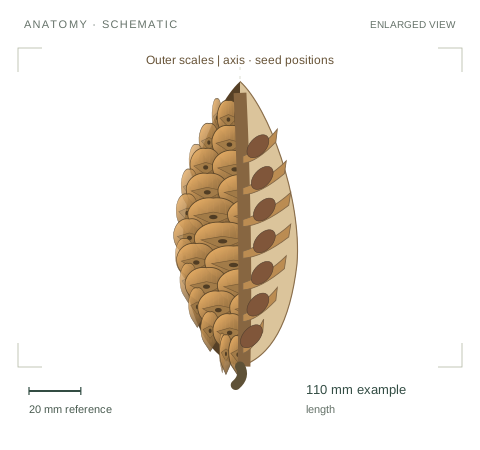
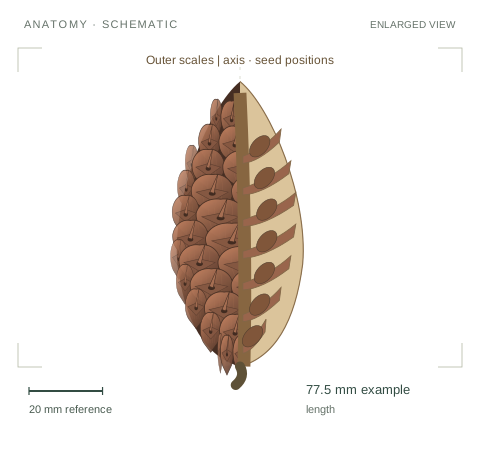
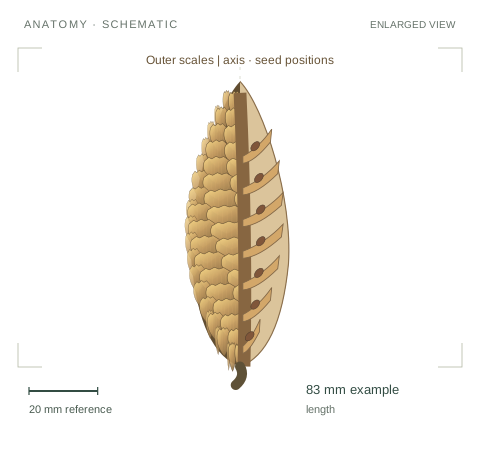
Ponderosa pine section: Two seed positions sit near the base of each fertile scale. A longitudinal section shows one of each pair.
Schematic sectionOpen SVG ↗

DRAWER 02 · Pinaceae

Colorado pinyon

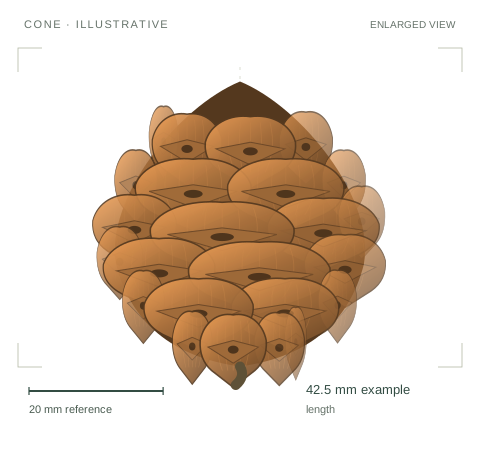
A compact cone with large, blunt scale faces.
The opened cone becomes rounded and broad. Its large wingless seeds contrast with the winged ponderosa seed.
Pinus edulis

Cone length: 35–50 mm. About 40 mm in the FNA account; endpoints include its parenthetical limits.
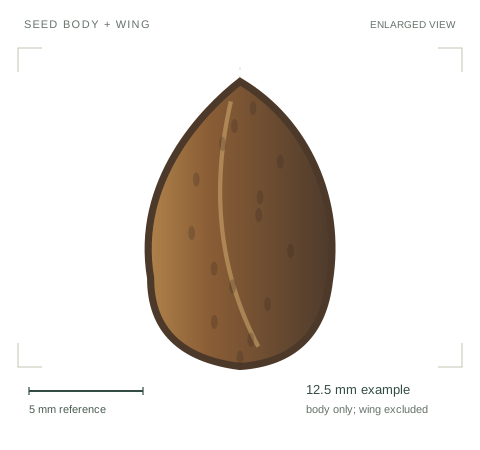
Seed body: 10–15 mm. Seed body only.
Wingless. Cone source · Seed source

Colorado pinyon cone: A compact cone with large, blunt scale faces.
Cone formOpen SVG ↗
Colorado pinyon seed: Large, wingless body
Seed and wingOpen SVG ↗
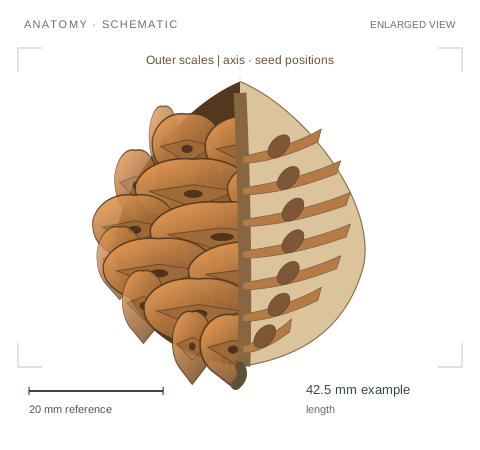
Colorado pinyon section: Seeds occupy recesses on the upper face of fertile scales. Seed cavities and wall thickness are schematic here.
Schematic sectionOpen SVG ↗

DRAWER 03 · Pinaceae

Limber pine

Thick, smooth scale ends without prickles.
The long cone and unarmed scales separate this form from the smaller bristled cone in the next drawer.
Pinus flexilis

Cone length: 70–150 mm. Range-wide cone length.
Seed body: 10–15 mm. Seed body only; a small residual wing may occur.
Wingless or nearly so. Cone source · Seed source

Limber pine cone: Thick, smooth scale ends without prickles.
Cone formOpen SVG ↗
Limber pine seed: Large body; little or no wing
Seed and wingOpen SVG ↗
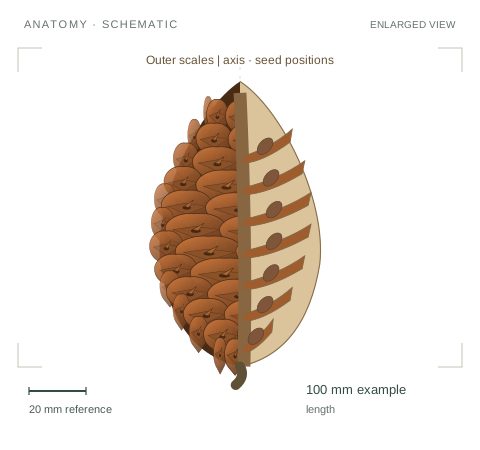
Limber pine section: The central axis supports woody scales. The drawing uses a few seed positions to explain the structure, not to count seeds.
Schematic sectionOpen SVG ↗

DRAWER 04 · Pinaceae

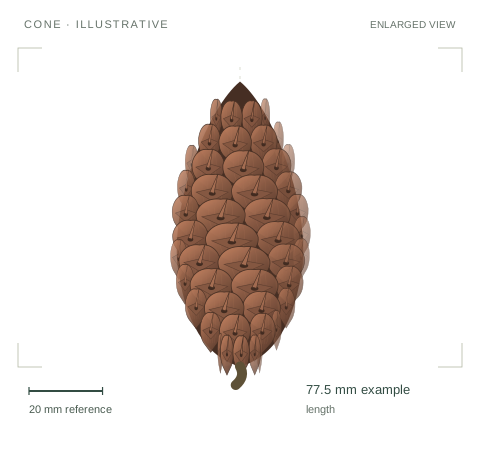
Great Basin bristlecone

Slender bristles rise from thickened scale faces.
A pointed outline carries the namesake bristles. Their described length is 1–6 mm; the drawing uses a 5 mm example.
Pinus longaeva

Cone length: 60–95 mm. Range-wide cone length; bristles are variable.
Seed body: 5–8 mm. Seed body only.
10–12 mm wing. Cone source · Seed source

Great Basin bristlecone cone: Slender bristles rise from thickened scale faces.
Cone formOpen SVG ↗
Great Basin bristlecone seed: Small body with a distinct wing
Seed and wingOpen SVG ↗
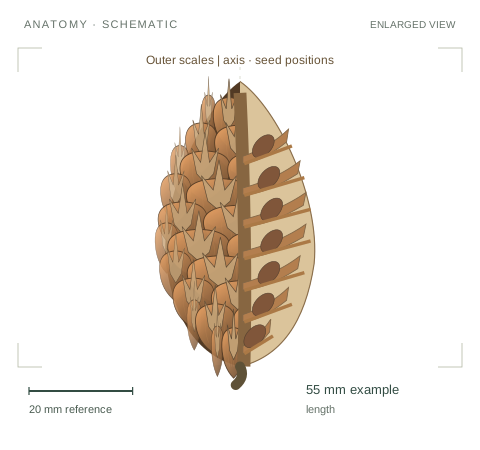
Great Basin bristlecone section: The bristle is part of the scale tip, not a seed wing. The seeds remain behind the scales until release.
Schematic sectionOpen SVG ↗

DRAWER 05 · Pinaceae

Rocky Mountain Douglas-fir

Three-pointed bracts project between the scales.
Each bract has a long middle tip and two shorter side tips. It is a separate structure from the rounded seed scale.
Pseudotsuga menziesii var. glauca

Cone length: 40–70 mm. Rocky Mountain variety glauca; not the larger coastal variety.
Seed body: 5–6 mm. Species-level seed body range. Wing drawn 1.8× body for explanation; only “longer” is sourced.
Wing longer than body. Cone source · Seed source

Rocky Mountain Douglas-fir cone: Three-pointed bracts project between the scales.
Cone formOpen SVG ↗
Rocky Mountain Douglas-fir seed: Winged, small angular body
Seed and wingOpen SVG ↗
Rocky Mountain Douglas-fir section: A bract lies below its seed-bearing scale. This section separates them so their different roles remain visible.
Schematic sectionOpen SVG ↗

DRAWER 06 · Pinaceae

White fir

Upright cylindrical cones with overlapping fan-shaped scales.
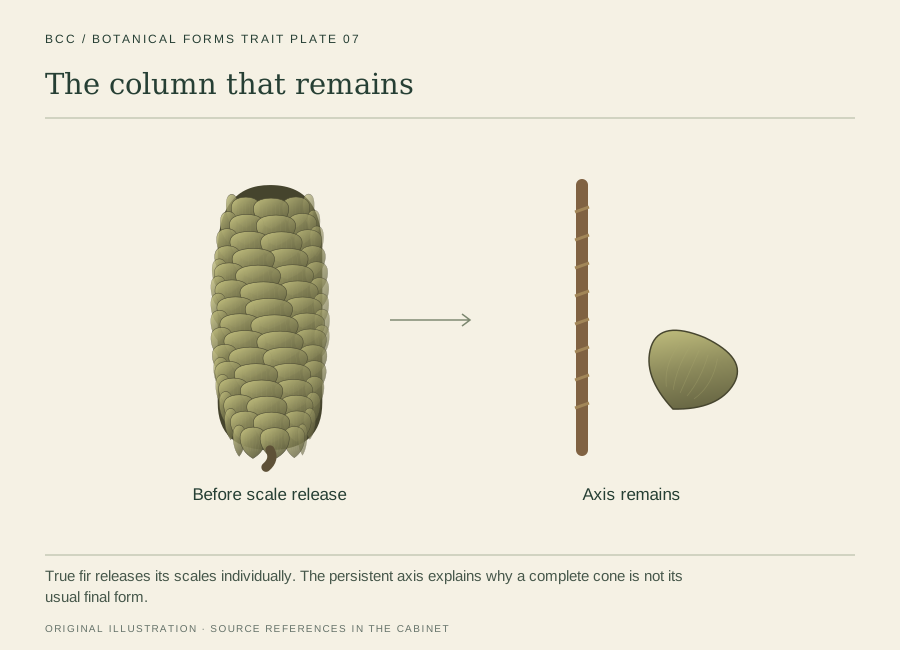
A fir cone comes apart scale by scale. The central axis stays on the branch after the scales and seeds separate.
Abies concolor

Cone length: 70–120 mm. FNA also reports width 30–45 mm. Drawing uses 37.5 mm.
Seed body: 8–12 mm. Seed body only; wing length is approximate, not an independently measured interval.
Wing about 2× body. Cone source · Seed source

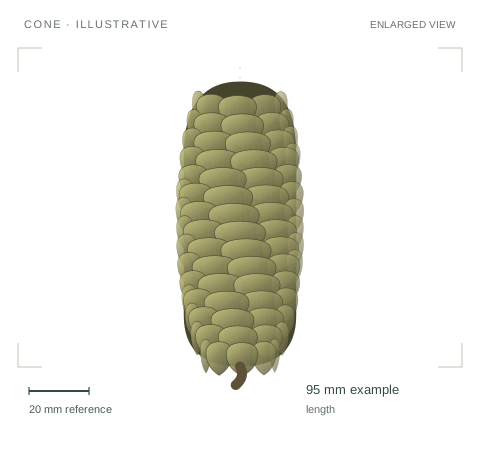
White fir cone: Upright cylindrical cones with overlapping fan-shaped scales.
Cone formOpen SVG ↗
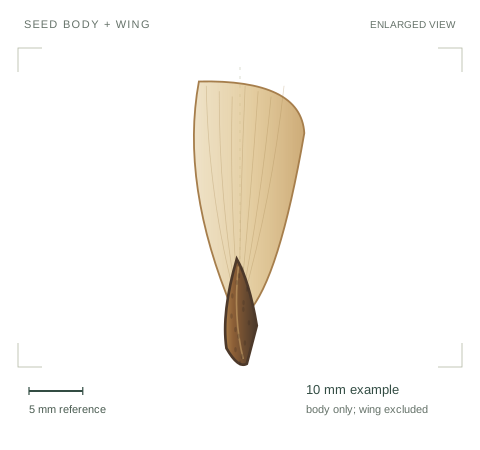
White fir seed: Broad wing on an angular body
Seed and wingOpen SVG ↗
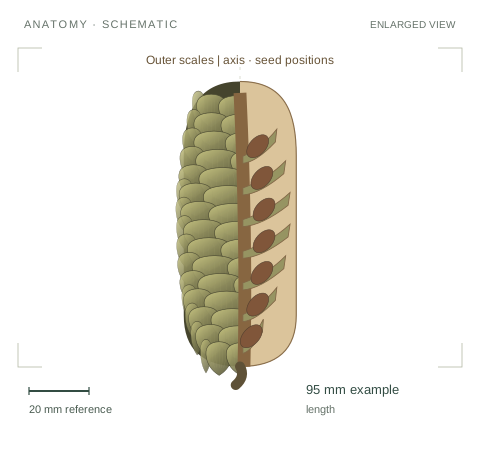
White fir section: Fan-shaped seed scales attach to a persistent axis. The pale central column is an explanatory section, not a scanned interior.
Schematic sectionOpen SVG ↗

DRAWER 07 · Pinaceae

Blue spruce

Thin, flexible scales give the cone a papery edge.
The mature cone hangs down. The wavy scale margins in this drawing emphasize texture; they are not a microscope record.
Picea pungens

Cone length: 64–102 mm. USDA FEIS range; other botanical accounts use somewhat different endpoints.
Seed body: about 3 mm. Approximate value in USDA FEIS, not a measured range or Bryce sample.
Wing about 2× body. Cone source · Seed source

Blue spruce cone: Thin, flexible scales give the cone a papery edge.
Cone formOpen SVG ↗
Blue spruce seed: Tiny body with a papery wing
Seed and wingOpen SVG ↗
Blue spruce section: Two seed positions belong to each fertile scale. Only one is shown on each side in this simplified lengthwise slice.
Schematic sectionOpen SVG ↗

DRAWER 08 · Cupressaceae

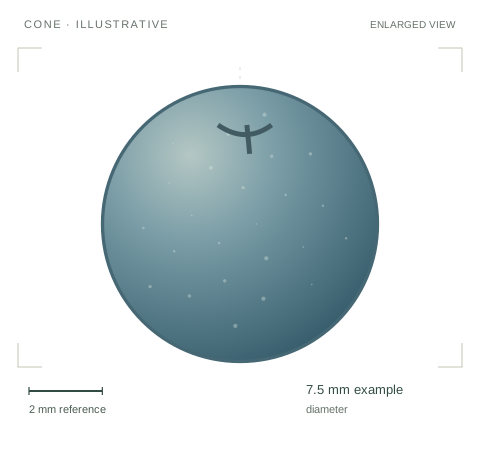
Rocky Mountain juniper

A rounded cone whose scales are fused together.
Its berry-like outline belongs to a cone. A pale waxy bloom covers a darker surface; two seeds are a typical example.
Juniperus scopulorum

Cone diameter: 6–9 mm across. Diameter, not cone length. Much smaller than the woody cones.
Seed body: 4–5 mm. Individual seed body; number per cone usually two, occasionally one or three.
Wingless. Cone source · Seed source

Rocky Mountain juniper cone: A rounded cone whose scales are fused together.
Cone formOpen SVG ↗
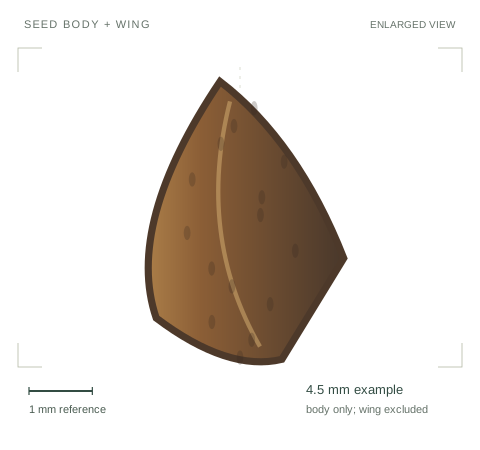
Rocky Mountain juniper seed: Wingless, rounded to faceted body
Seed and wingOpen SVG ↗
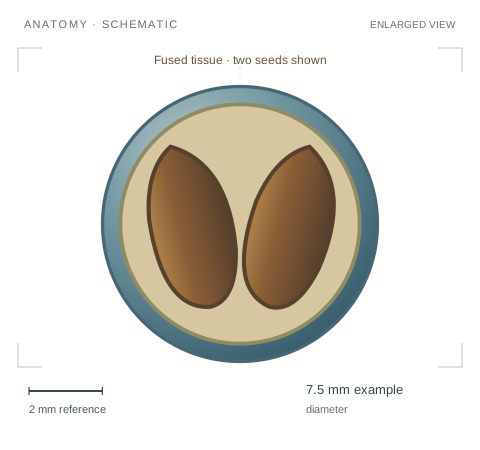
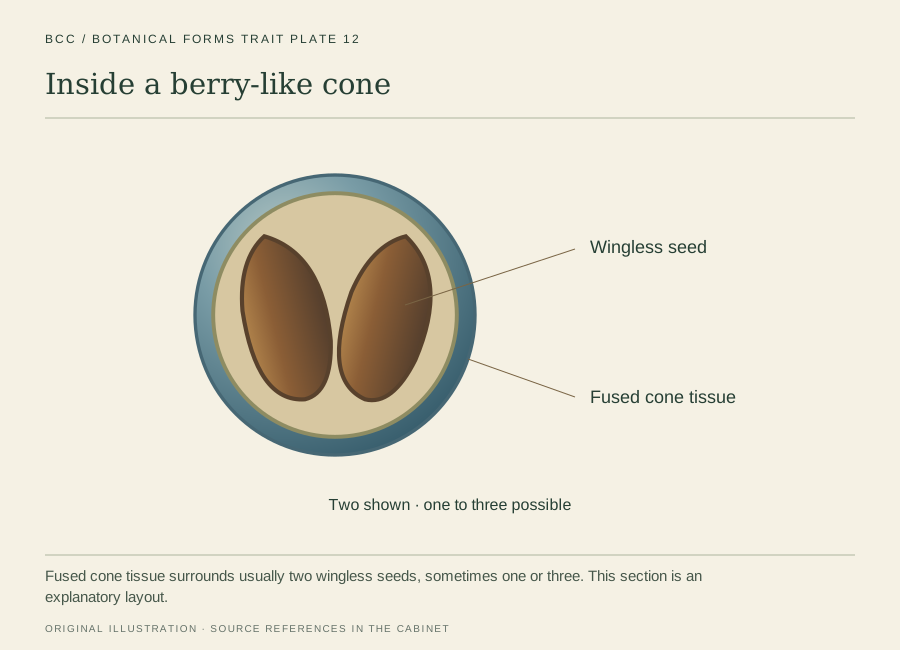
Rocky Mountain juniper section: A schematic cross-section shows two seeds inside fused cone tissue. One or three seeds can also occur; positions and tissue thickness vary.
Schematic sectionOpen SVG ↗

Twelve trait plates

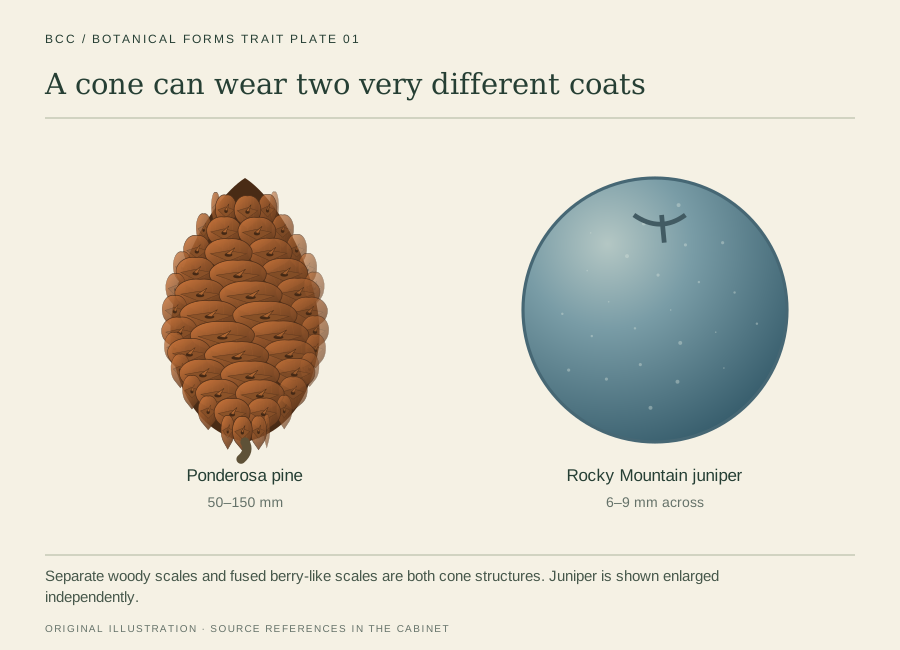
Trait plate 1: A cone can wear two very different coats. Separate woody scales and fused berry-like scales are both cone structures. Juniper is shown enlarged independently.
Plate 01 · Open to read

A cone can wear two very different coats

Separate woody scales and fused berry-like scales are both cone structures. Juniper is shown enlarged independently.

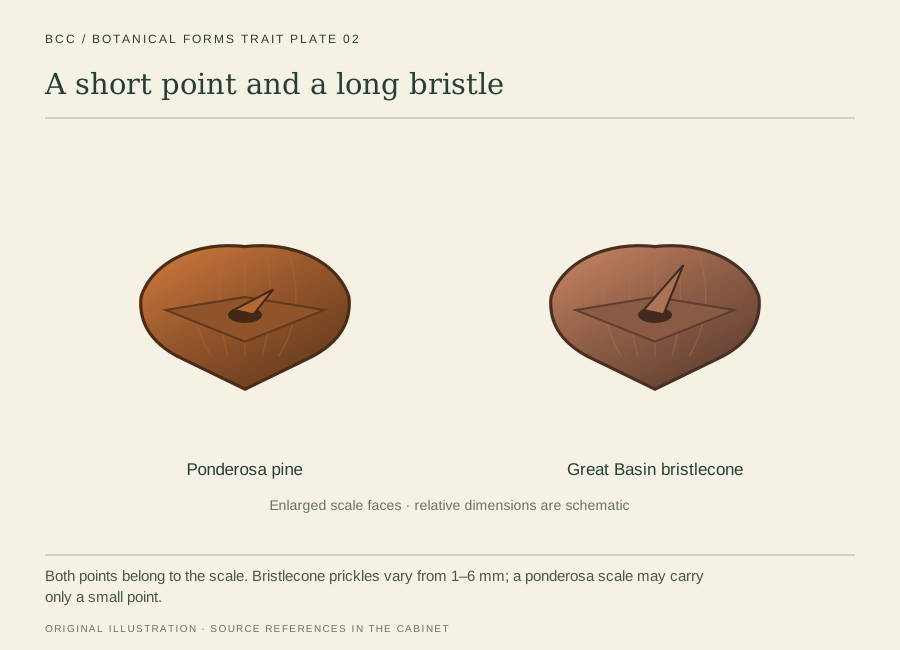
Trait plate 2: A short point and a long bristle. Both points belong to the scale. Bristlecone prickles vary from 1–6 mm; a ponderosa scale may carry only a small point.
Plate 02 · Open to read

A short point and a long bristle

Both points belong to the scale. Bristlecone prickles vary from 1–6 mm; a ponderosa scale may carry only a small point.

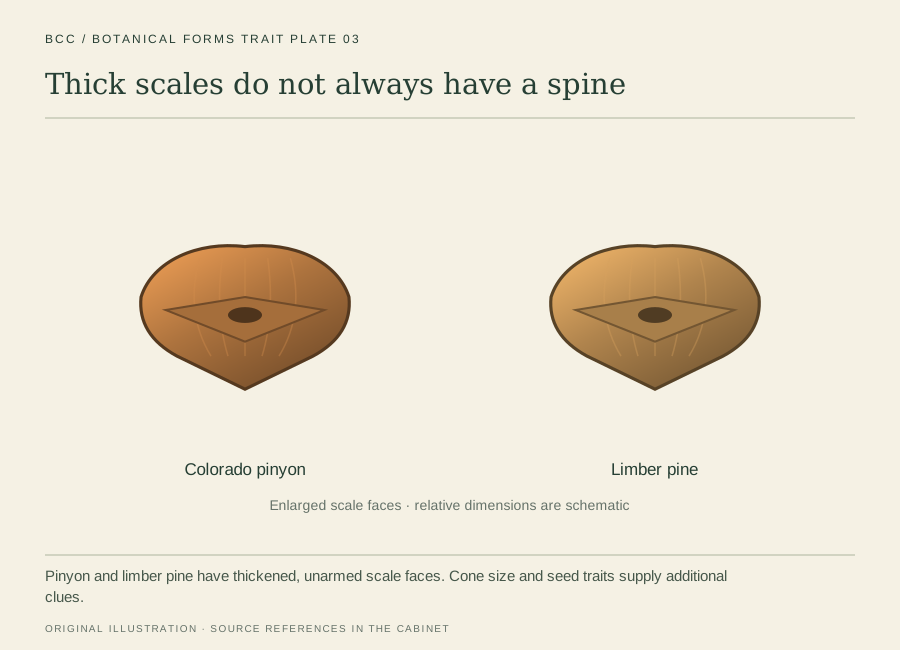
Trait plate 3: Thick scales do not always have a spine. Pinyon and limber pine have thickened, unarmed scale faces. Cone size and seed traits supply additional clues.
Plate 03 · Open to read

Thick scales do not always have a spine

Pinyon and limber pine have thickened, unarmed scale faces. Cone size and seed traits supply additional clues.

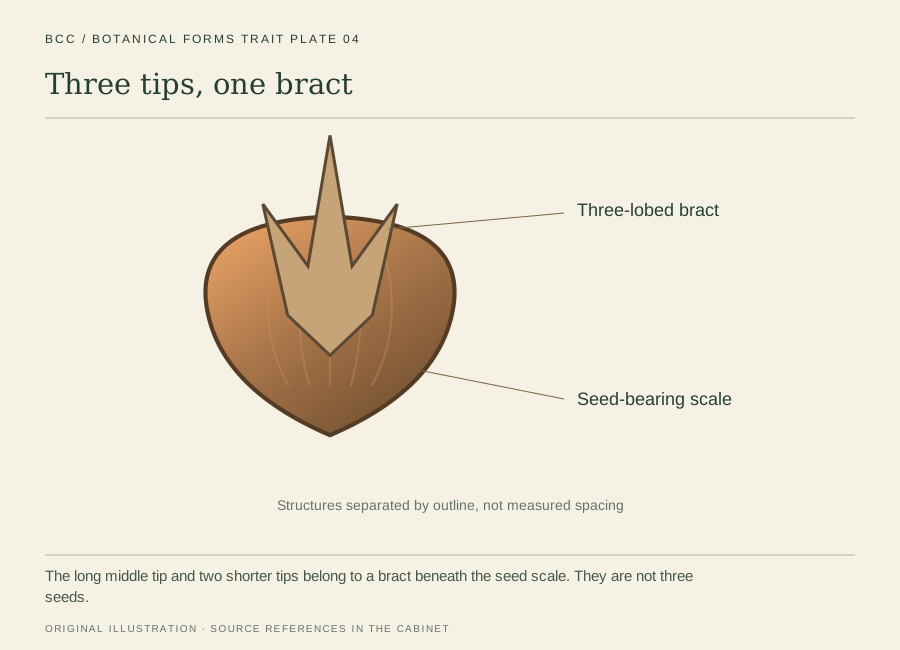
Trait plate 4: Three tips, one bract. The long middle tip and two shorter tips belong to a bract beneath the seed scale. They are not three seeds.
Plate 04 · Open to read

Three tips, one bract

The long middle tip and two shorter tips belong to a bract beneath the seed scale. They are not three seeds.

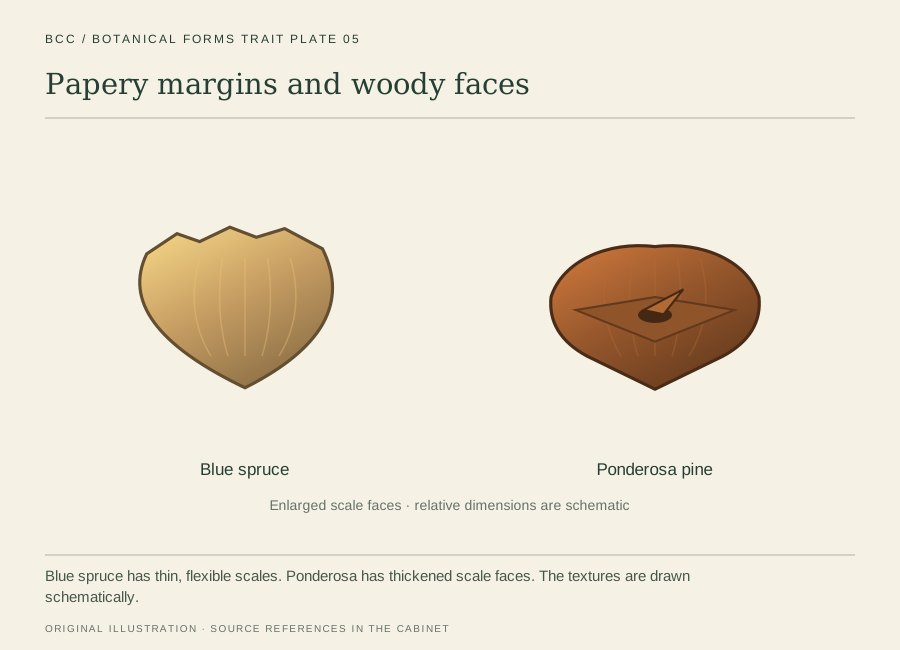
Trait plate 5: Papery margins and woody faces. Blue spruce has thin, flexible scales. Ponderosa has thickened scale faces. The textures are drawn schematically.
Plate 05 · Open to read

Papery margins and woody faces

Blue spruce has thin, flexible scales. Ponderosa has thickened scale faces. The textures are drawn schematically.

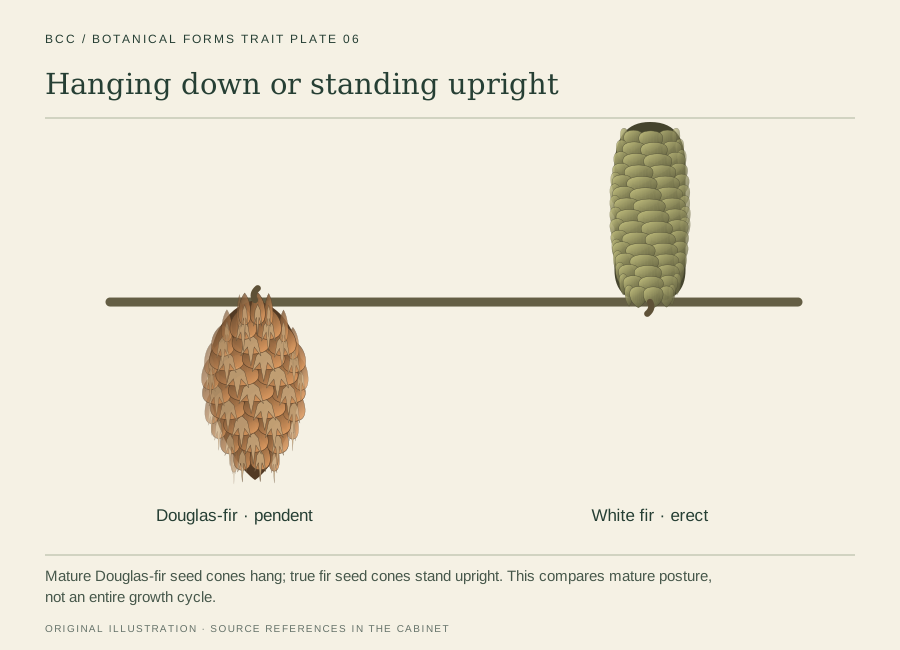
Trait plate 6: Hanging down or standing upright. Mature Douglas-fir seed cones hang; true fir seed cones stand upright. This compares mature posture, not an entire growth cycle.
Plate 06 · Open to read

Hanging down or standing upright

Mature Douglas-fir seed cones hang; true fir seed cones stand upright. This compares mature posture, not an entire growth cycle.

Trait plate 7: The column that remains. True fir releases its scales individually. The persistent axis explains why a complete cone is not its usual final form.
Plate 07 · Open to read

The column that remains

True fir releases its scales individually. The persistent axis explains why a complete cone is not its usual final form.

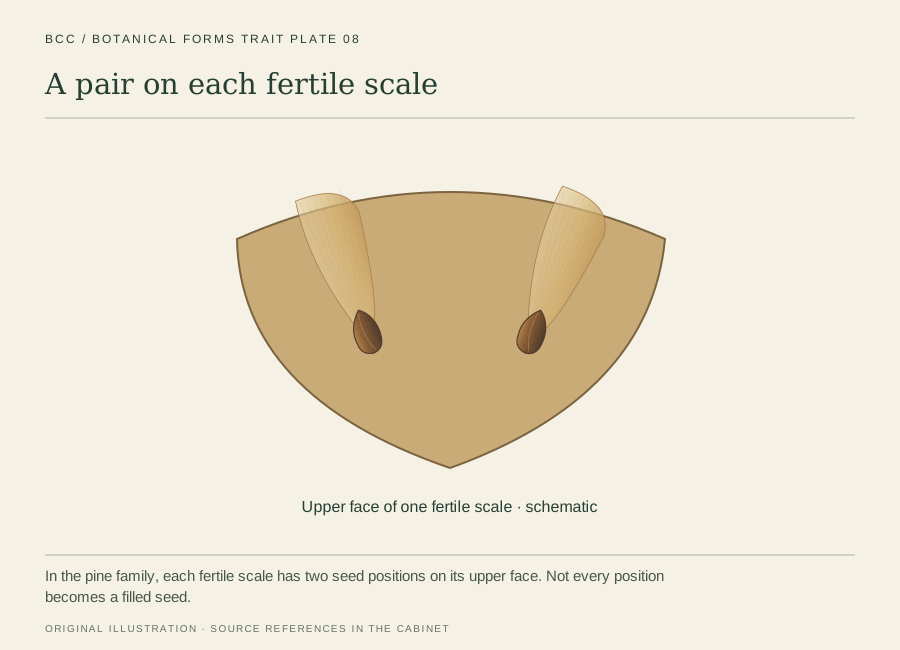
Trait plate 8: A pair on each fertile scale. In the pine family, each fertile scale has two seed positions on its upper face. Not every position becomes a filled seed.
Plate 08 · Open to read

A pair on each fertile scale

In the pine family, each fertile scale has two seed positions on its upper face. Not every position becomes a filled seed.

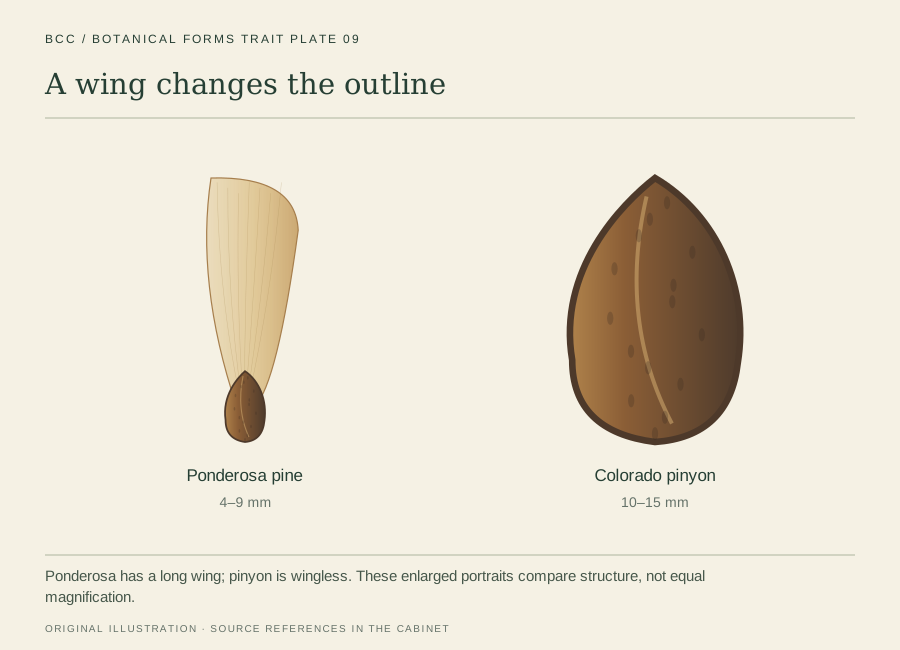
Trait plate 9: A wing changes the outline. Ponderosa has a long wing; pinyon is wingless. These enlarged portraits compare structure, not equal magnification.
Plate 09 · Open to read

A wing changes the outline

Ponderosa has a long wing; pinyon is wingless. These enlarged portraits compare structure, not equal magnification.

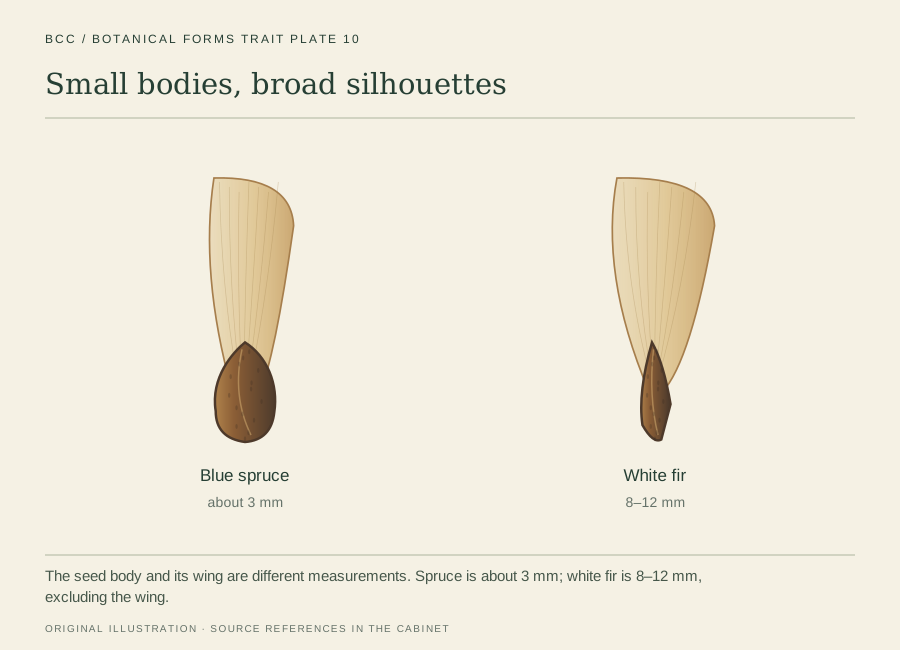
Trait plate 10: Small bodies, broad silhouettes. The seed body and its wing are different measurements. Spruce is about 3 mm; white fir is 8–12 mm, excluding the wing.
Plate 10 · Open to read

Small bodies, broad silhouettes

The seed body and its wing are different measurements. Spruce is about 3 mm; white fir is 8–12 mm, excluding the wing.

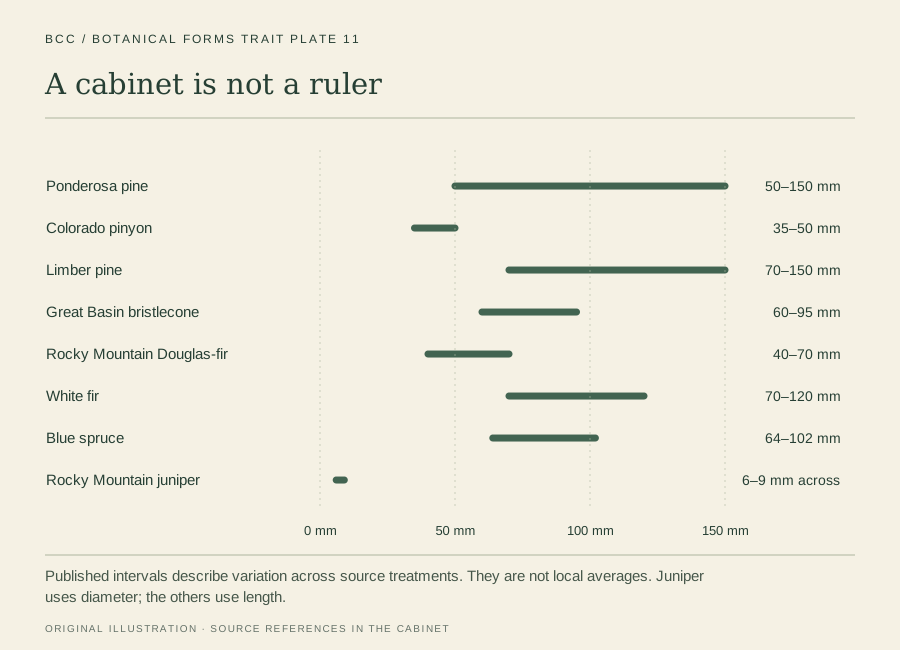
Trait plate 11: A cabinet is not a ruler. Published intervals describe variation across source treatments. They are not local averages. Juniper uses diameter; the others use length.
Plate 11 · Open to read

A cabinet is not a ruler

Published intervals describe variation across source treatments. They are not local averages. Juniper uses diameter; the others use length.

Trait plate 12: Inside a berry-like cone. Fused cone tissue surrounds usually two wingless seeds, sometimes one or three. This section is an explanatory layout.
Plate 12 · Open to read

Inside a berry-like cone

Fused cone tissue surrounds usually two wingless seeds, sometimes one or three. This section is an explanatory layout.

Read the form.
Keep the limits in view.

Original botanical illustrations. No collected Bryce specimens, scans or field measurements. Shape, color, scale count and interior layout are schematic. Dimensions come from published descriptions; they are not measurements made here. Color and posture vary with maturity. This is a form study, not a complete identification key. No eating, collecting or propagation guidance is provided.

REFERENCE SHELF

Sources behind the drawings

Botanical descriptions guide the traits. Park references establish context; these drawings do not document individual trees.
  • Trees and Shrubs · Bryce Canyon ↗National Park Service · 2022-06-29

    Park context for seven named conifers; white fir also mentioned in the forest description.

    Checked 2026-10-02. Factual paraphrase only. No source photographs, maps or drawings are reused.
  • Bristlecone Loop Trailhead ↗National Park Service · 2024-10-10

    White fir occurs in the Bryce forest. No individual tree coordinates retained.

    Checked 2026-10-02. Factual paraphrase only. No source photographs, maps or drawings are reused.
  • Pinus ponderosa · Flora of North America, vol. 2 ↗Flora of North America / eFloras · 1993

    Species-level cone length 5–15 cm, seed body (3–)4–9 mm, wing 15–25 mm; woody raised scales and variable prickles.

    Checked 2026-10-02. Factual paraphrase only. No source photographs, maps or drawings are reused.
  • Pinus edulis · Flora of North America, vol. 2 ↗Flora of North America / eFloras · 1993

    Cone length 3.5–5 cm (about 4 cm); seed body 10–15 mm and wingless; broad open cone and raised scales.

    Checked 2026-10-02. Factual paraphrase only. No source photographs, maps or drawings are reused.
  • Pinus flexilis · Flora of North America, vol. 2 ↗Flora of North America / eFloras · 1993

    Cone length 7–15 cm; seed body 10–15 mm, wingless or nearly so; thick scale ends without prickles.

    Checked 2026-10-02. Factual paraphrase only. No source photographs, maps or drawings are reused.
  • Pinus longaeva · Robert Kral, Flora of North America, vol. 2 ↗Flora of North America, mirrored by Great Plains Herbaria · 1993

    Cone length 6–9.5 cm; seed body 5–8 mm and wing 10–12 mm; slender stiff prickles 1–6 mm.

    Checked 2026-10-02. Factual paraphrase only. No source photographs, maps or drawings are reused.
  • Pseudotsuga menziesii · Flora of North America, vol. 2 ↗Flora of North America / eFloras · 1993

    Rocky Mountain variety glauca cone length 4–7 cm and spreading/reflexed bracts; species seed length 5–6 mm, wing longer than body.

    Checked 2026-10-02. Factual paraphrase only. No source photographs, maps or drawings are reused.
  • Pseudotsuga · Flora of China, vol. 4 ↗Flora of China / eFloras · 1999

    Pendent seed cones and three-lobed bracts with longer central cusp; genus-level anatomy.

    Checked 2026-10-02. Factual paraphrase only. No source photographs, maps or drawings are reused.
  • Abies concolor · Flora of North America, vol. 2 ↗Flora of North America / eFloras · 1993

    Cone length 7–12 cm, width 3–4.5 cm; seed body 8–12 mm; wing about twice as long as body; included bracts.

    Checked 2026-10-02. Factual paraphrase only. No source photographs, maps or drawings are reused.
  • Abies · Flora of North America, vol. 2 ↗Flora of North America / eFloras · 1993

    Upright seed cones shed individual scales, leaving the central axis; fan-shaped scales.

    Checked 2026-10-02. Factual paraphrase only. No source photographs, maps or drawings are reused.
  • Picea pungens · Fire Effects Information System ↗USDA Forest Service · 1993-05

    Cone length 6.4–10.2 cm with thin flexible scales; seed about 3 mm, about half the wing length. Sources differ; no false seed range is inferred.

    Checked 2026-10-02. Factual paraphrase only. No source photographs, maps or drawings are reused.
  • Blue Spruce · Silvics of North America ↗USDA Forest Service · 1990-12-01

    Mature seed cones become pendent; young pollination-stage posture differs.

    Checked 2026-10-02. Factual paraphrase only. No source photographs, maps or drawings are reused.
  • Juniperus scopulorum · Flora of North America, vol. 2 ↗Flora of North America / eFloras · 1993

    Cone diameter 6–9 mm; seeds 4–5 mm; usually two, sometimes one or three; blue waxy surface.

    Checked 2026-10-02. Factual paraphrase only. No source photographs, maps or drawings are reused.
  • Juniperus · Flora of North America, vol. 2 ↗Flora of North America / eFloras · 1993

    Fused fleshy or fibrous seed-cone scales; wingless seeds.

    Checked 2026-10-02. Factual paraphrase only. No source photographs, maps or drawings are reused.
  • Pinaceae · Flora of North America, vol. 2 ↗Flora of North America / eFloras · 1993

    Spiral bract-scale complexes, two seed positions on the upper face of each fertile scale; distinct scale and bract.

    Checked 2026-10-02. Factual paraphrase only. No source photographs, maps or drawings are reused.