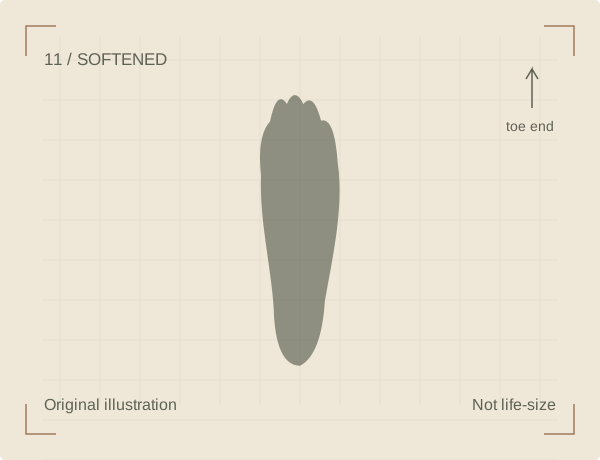
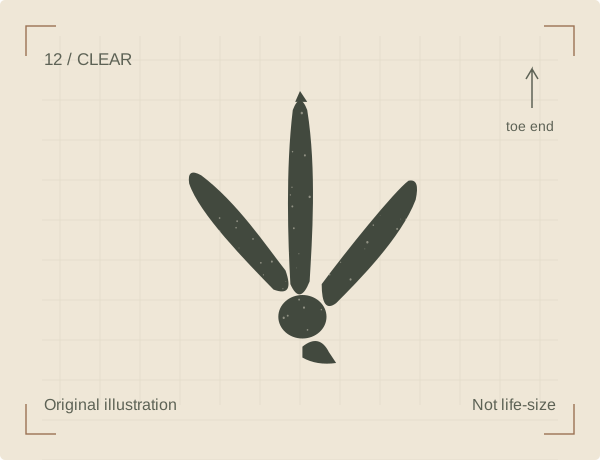
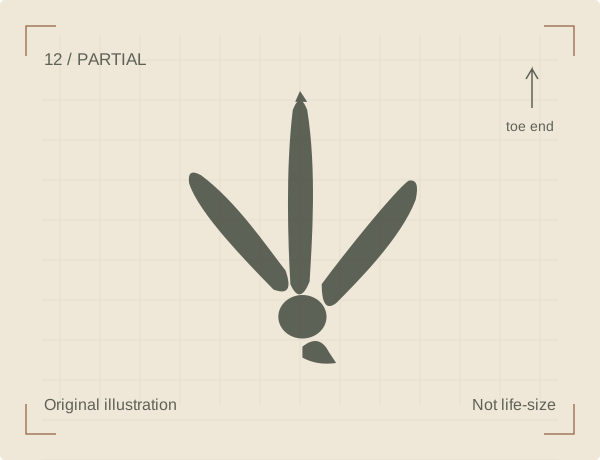
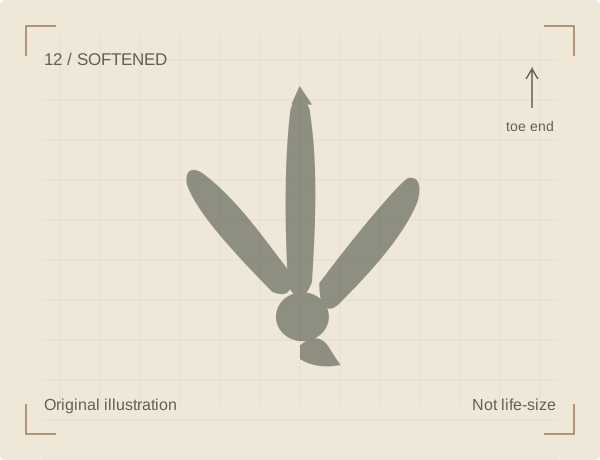
Original teaching illustrations, not photographs or field observations. Shapes are generalized; size references come from regional guides, not a Bryce measurement survey. A match is a possibility, not a confirmed identification.
Twelve plates, three impression states each, four changing substrates and four comparisons.
Start with what is visible. Count only the marks that actually register. A gap, lost toe or rounded edge is missing information. The clear study is an idealized drawing; it is not a species verdict.
All figures are independently enlarged, not life-size. Numeric references are regional ranges or single approximate examples as labeled. Widths without a published value remain illustrative. No drawing records a wildlife encounter.
Leave sign in place. Stay on established paths and do not follow prints toward an animal, burrow or nest.
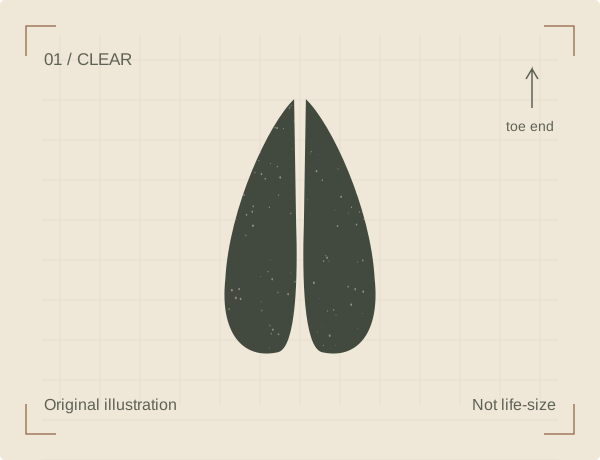
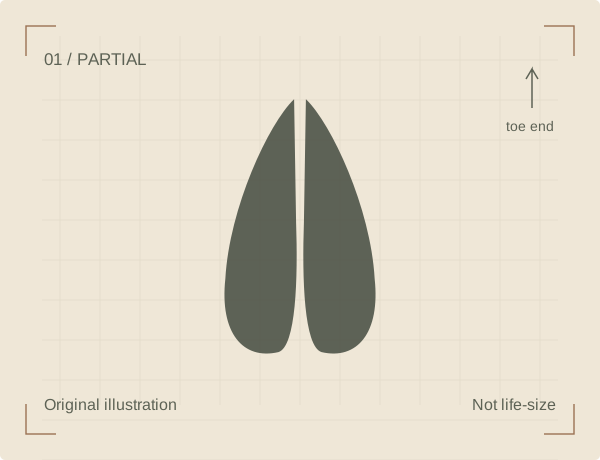
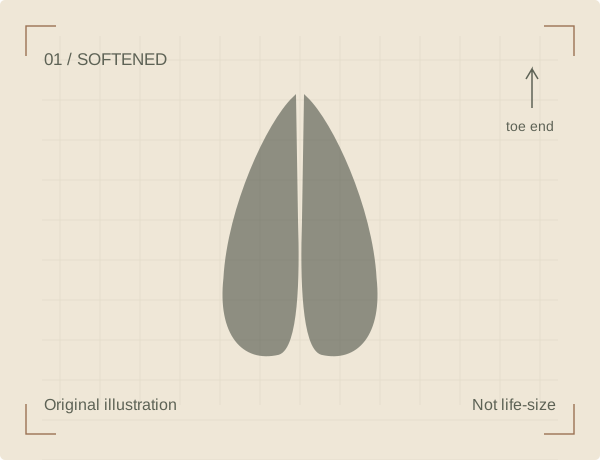
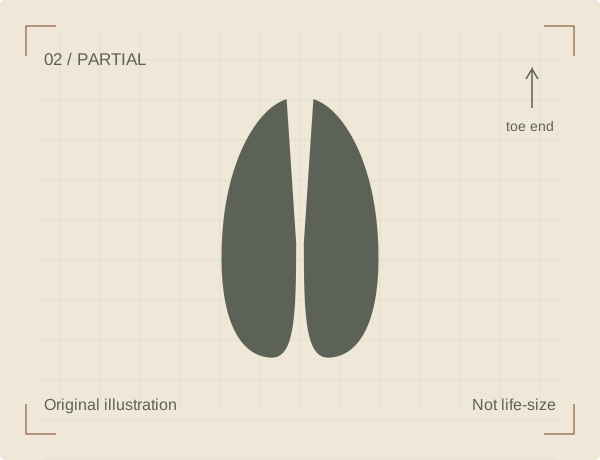
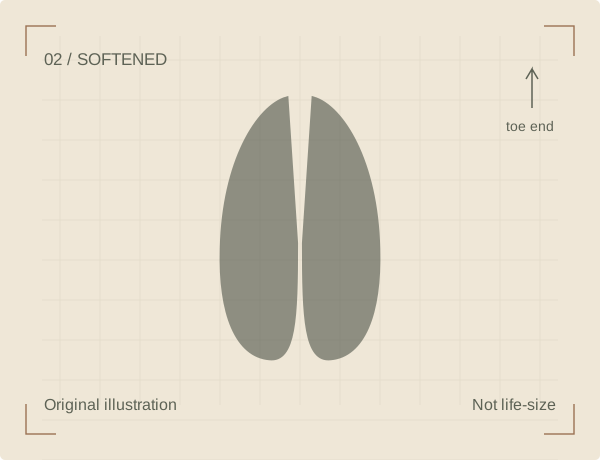
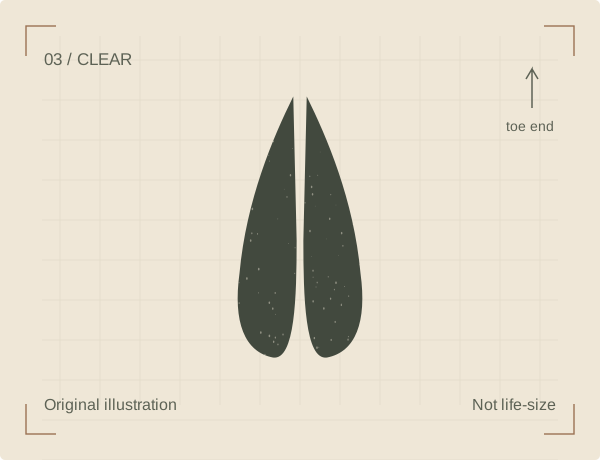
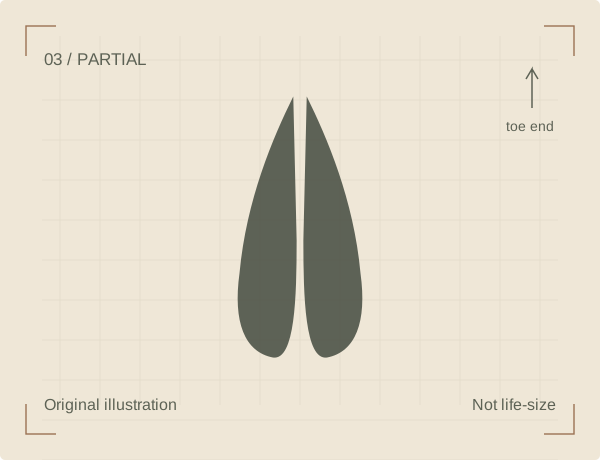
PLATE 01 / Hooves
Mule deer
Odocoileus hemionus · Forefoot study
Clear study. Independently enlarged; not life-size.
Read the form
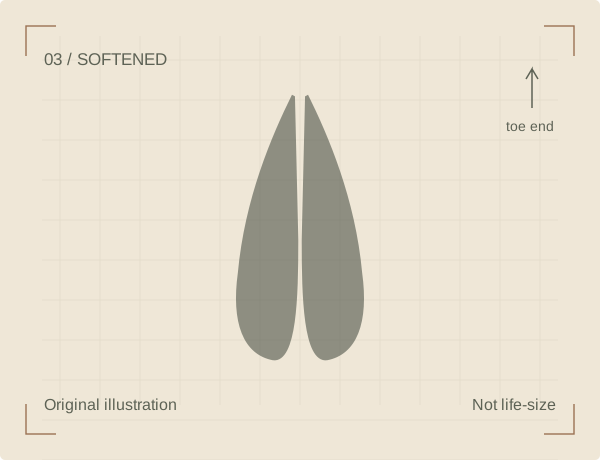
Two main hoof impressions, separated by a central cleft.
Tips can look pointed or worn and blunt.
Partial or splayed impressions lose the familiar outline.
Adult deer track length
6–8.3 cm (2.4–3.3 in)
General deer reference; mule and white-tailed deer are not reliably separated by a print. Width is an artistic proportion, not a sourced range.
Keep the uncertainty. Deer and pronghorn can overlap. A split hoof alone does not establish mule deer, age or sex.
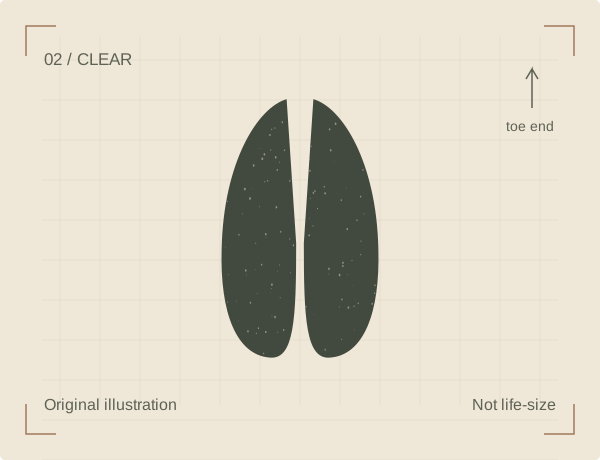
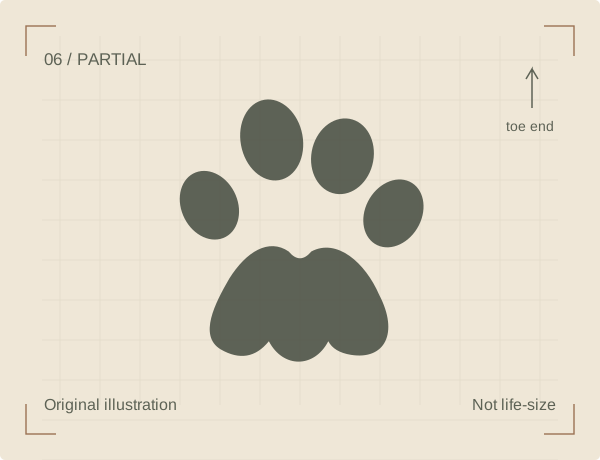
Partial. The left hoof tip and lower edge are missing. The surviving half is not a complete shape.Softened. The cleft becomes shallow and the tips round off. Apparent size is unreliable.
Clear study. Independently enlarged; not life-size.
Read the form
Two broad hoof impressions.
A rounder outline than the deer study.
Deep or soft ground can spread the hooves.
Adult elk track length
10.2–12.1 cm (4–4.8 in)
General adult reference, not a boundary that excludes juveniles. Width is illustrative.
Keep the uncertainty. Young cattle can leave a similar outline. Size helps comparison but does not prove the species.
Partial. One toe tip and part of the heel are absent. A fragment should not be measured as a whole foot.Softened. Rounded edges and a fading cleft make a larger-looking depression, not a larger animal.
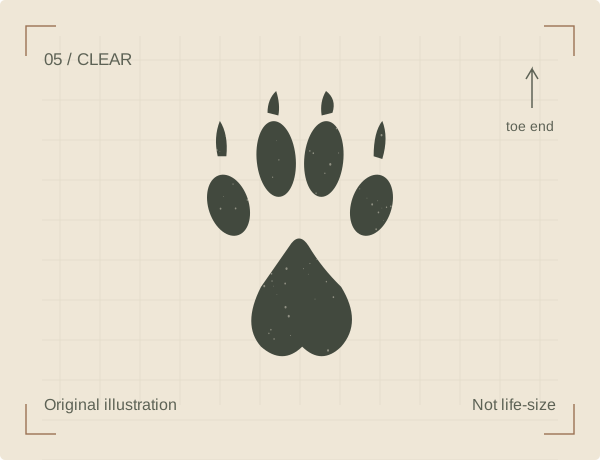
Clear study. Independently enlarged; not life-size.
Read the form
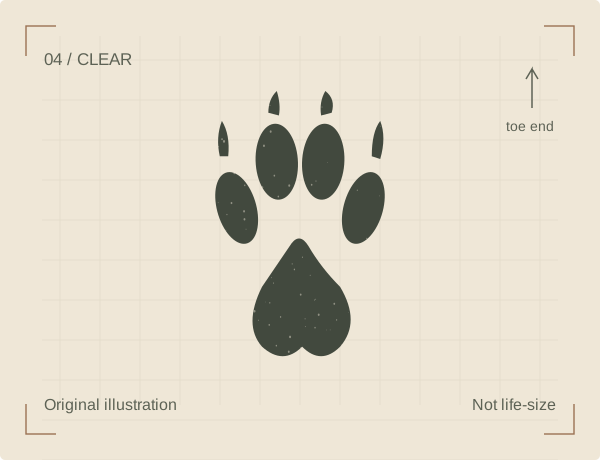
Four toe pads around a relatively compact palm pad.
The outline is longer than wide.
Claws may register; their absence does not prove a cat.
Foreprint length / width
5.4–7.9 × 4.1–6.4 cm (2.1–3.1 × 1.6–2.5 in)
Washington NPS reference range, converted from its inch values. Not a Bryce distribution or species cutoff.
Keep the uncertainty. Domestic dog and fox prints can overlap this form. A clear canine-like print can remain unidentified to species.
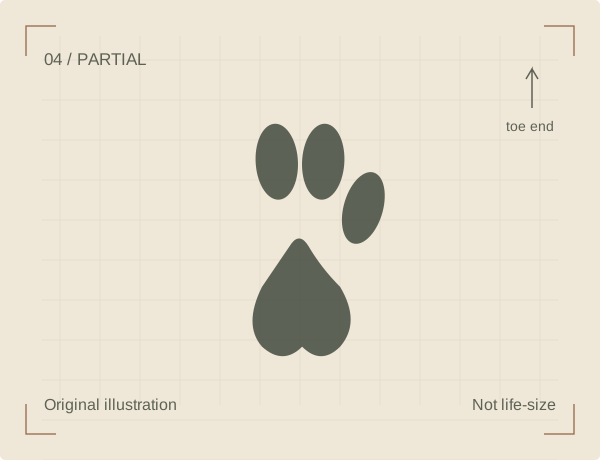
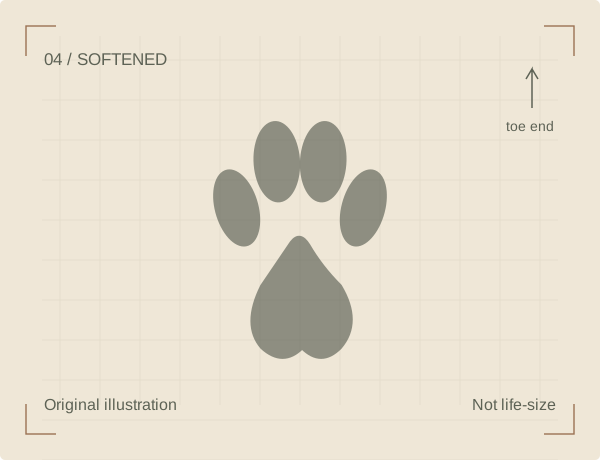
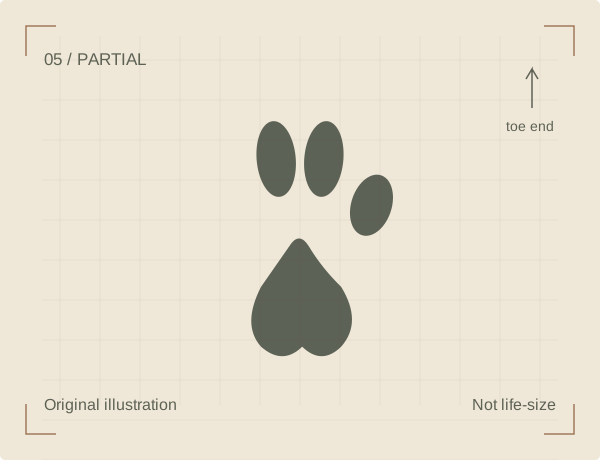
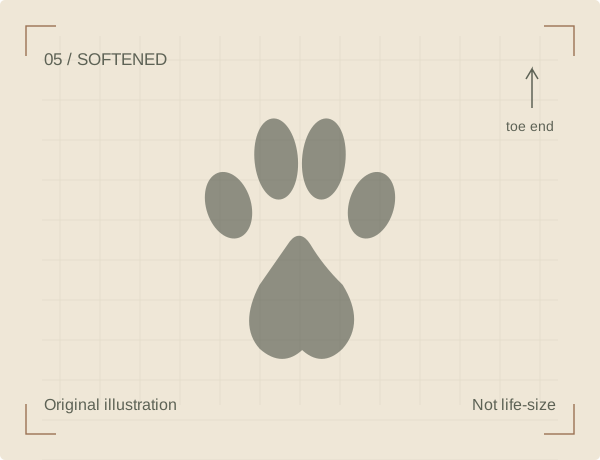
Partial. Claw marks and an outer toe are missing. Do not turn missing marks into absent anatomy.Softened. Pad and toe edges soften. Claw marks are not preserved in this invented example. Species cannot be confirmed.
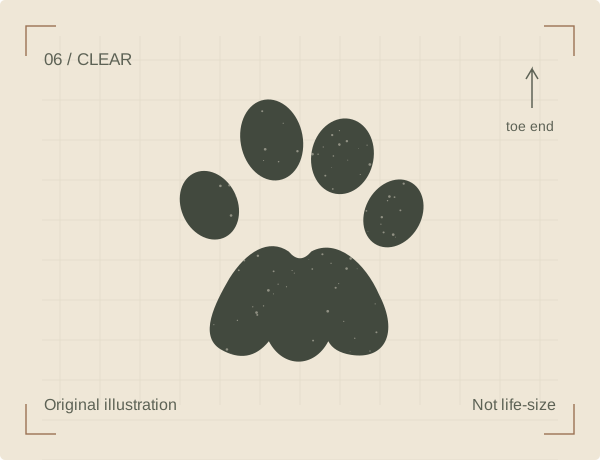
Clear study. Independently enlarged; not life-size.
Read the form
Four toe pads in an oval to squarish impression.
The middle claw marks may be clearest.
Foot fur can soften the pad edges even in a recent impression.
Foreprint length
5.1–5.7 cm (2–2.3 in)
Missouri reference. Do not substitute the Cascade red fox subspecies measurements for a Bryce-specific size range. Width is illustrative.
Keep the uncertainty. A small dog, coyote or other fox can leave a similar print. A soft edge is not a clock or a species test.
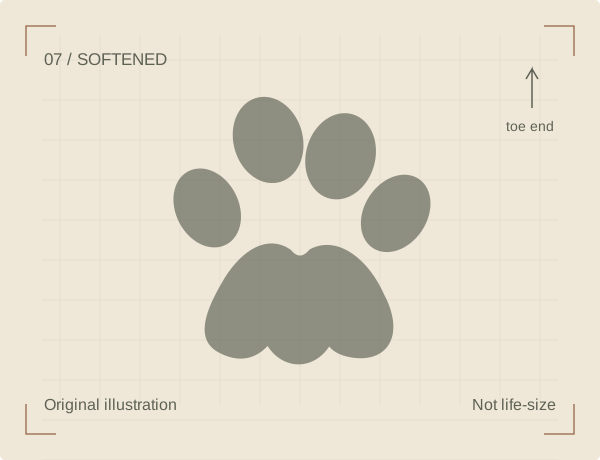
Partial. Claw marks and one outer toe do not register here; the fox-like silhouette is weakened.Softened. Toe boundaries soften. Natural foot fur can also reduce definition.
Clear study. Independently enlarged; not life-size.
Read the form
Four toe pads with one leading toe.
A broad palm pad with a two-lobed front and three-lobed rear.
Claws usually leave no mark in a relaxed impression.
Foreprint length / width
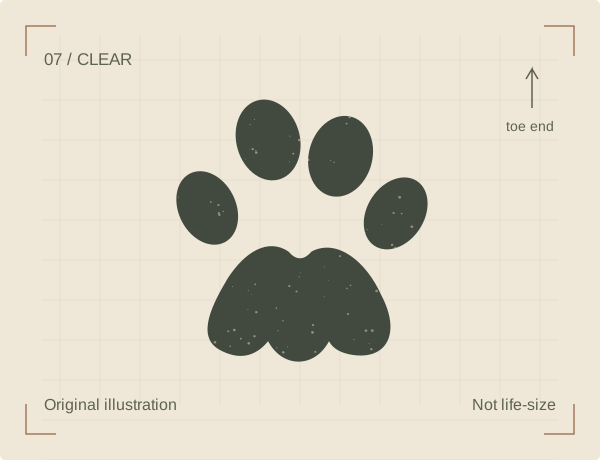
3.8–5.7 × 4.1–6 cm (1.5–2.3 × 1.6–2.4 in)
Washington NPS foreprint reference; inch values are the conversion authority. Soft ground and toe spread alter apparent dimensions.
Keep the uncertainty. Small feline prints overlap, and incomplete canid prints can lose claws. Pad detail and a reliable scale both matter.
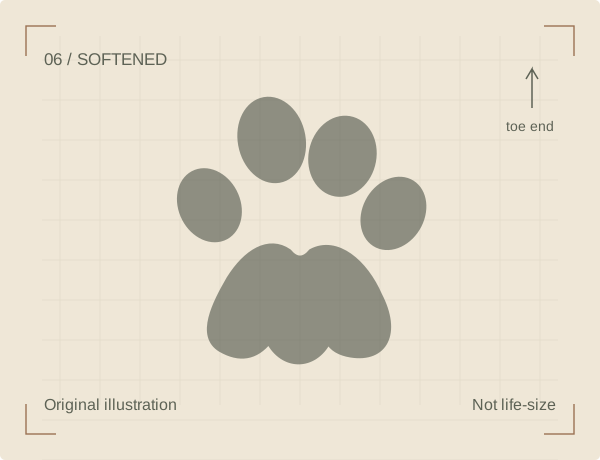
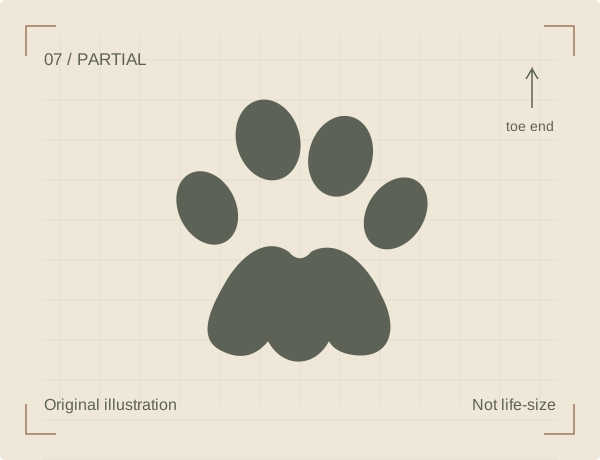
Partial. Part of the palm pad is gone. Counting its rear lobes is no longer possible.Softened. The pad lobes and toe edges become less distinct. Cat-like is only a tentative group description.
Clear study. Independently enlarged; not life-size.
Read the form
Four toe pads arranged with a leading toe.
A substantial palm pad; two front lobes and three rear lobes.
Claw marks are usually absent, but may appear.
Foreprint length / width
7.9–10.2 × 7–11.1 cm (3.1–4 × 2.8–4.4 in)
Washington NPS reference, not a guaranteed distinction from all other species or age classes.
Keep the uncertainty. A large dog print with missing claws can mislead. A single rounded depression is not evidence of a mountain lion.
Partial. The rear pad contour is interrupted. The identifying-looking lobes cannot be counted.Softened. The outline expands while the lobes fade. Apparent width is no longer a clean measurement.
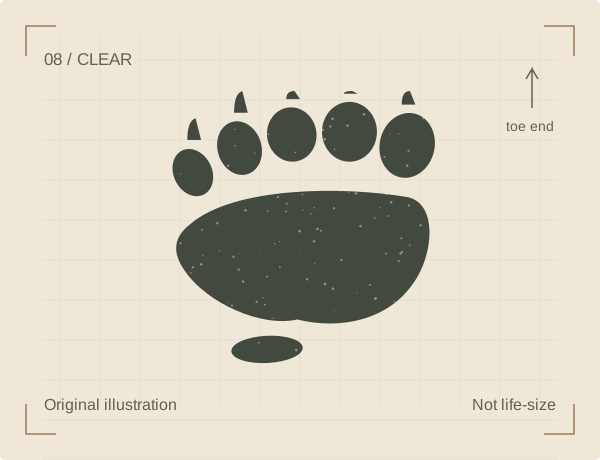
Clear study. Independently enlarged; not life-size.
Read the form
Five toe pads; the smallest inner toe may fail to register.
The largest toe lies on the outside of the foot.
A broad palm impression; a small rear pad may be absent.
Foreprint width example
8.9 cm approx. (3.5 in approx.)
NMSU gives a general 3.5-inch width example, not a range. Drawn length is an artistic proportion.
Keep the uncertainty. Four visible toes do not rule out a bear. An incomplete bear print can be confused with other paw shapes.
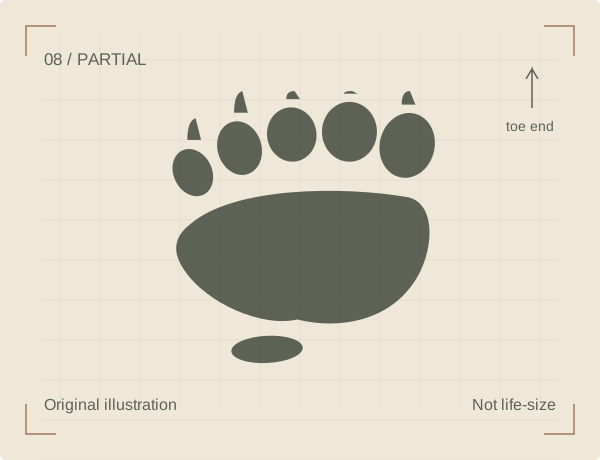
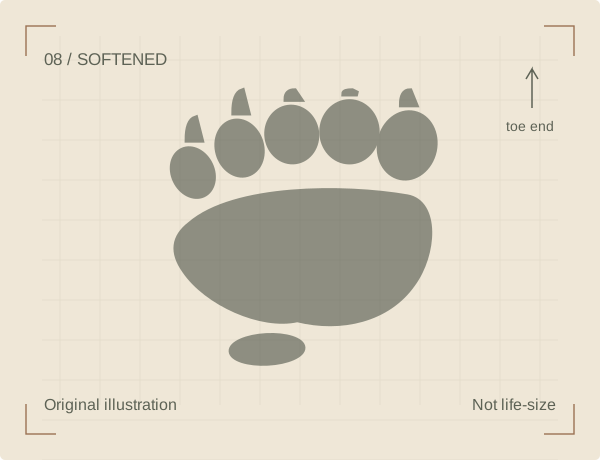
Partial. The small inner toe and the rear pad do not register in this variant.Softened. Five toe marks become hard to separate. A count from this outline is uncertain.
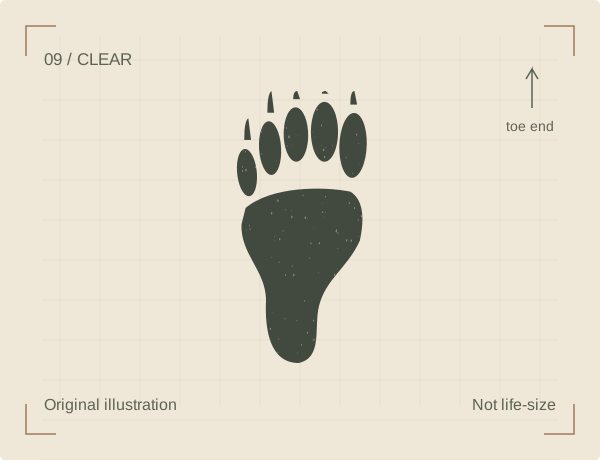
Clear study. Independently enlarged; not life-size.
Read the form
Five toes across the broad end.
An elongated sole and heel can register.
The largest toe is outside, unlike a human big toe.
Hindprint length / width example
17.8 × 8.9 cm approx. (7 × 3.5 in approx.)
Approximate NMSU reference dimensions, not minimum and maximum values. A partial heel makes a shorter apparent print.
Keep the uncertainty. The heel often changes how much of the foot is visible. A long sole-shaped mark alone does not establish bear.
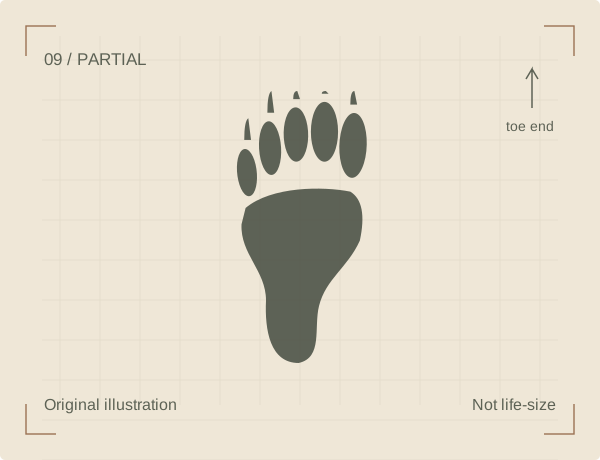
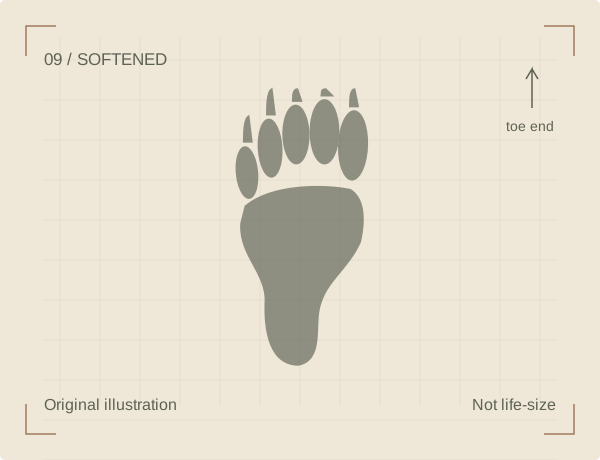
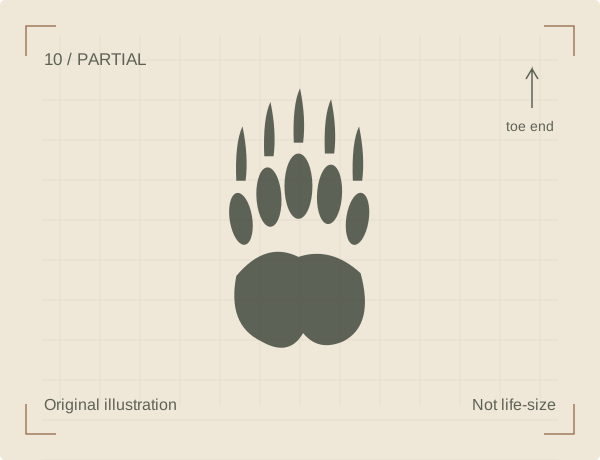
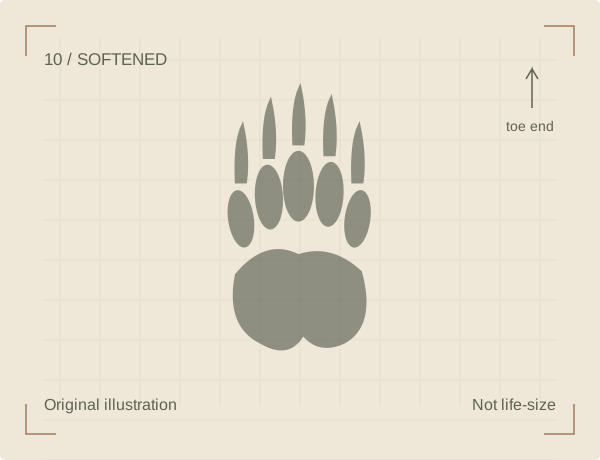
Partial. The heel and smallest toe are missing. The surviving print appears shorter and four-toed.Softened. Toe separation and the heel edge fade; the outline is an unreliable size reference.
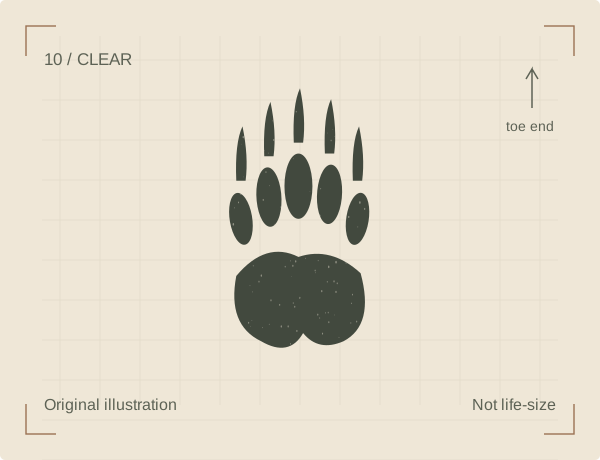
Clear study. Independently enlarged; not life-size.
Read the form
Five toe marks can register.
Long front claws extend beyond the toes.
Heel pads often fail to leave a distinct mark.
Foreprint length / width example
8.9 × 5.1 cm approx. (3.5 × 2 in approx.)
Missouri's approximate foreprint dimensions. Drawn long claw impressions are part of the example; the guide does not specify a standardized claw endpoint convention.
Keep the uncertainty. Digging and poor substrate can break up the print. Long scratches alone do not identify the maker.
Partial. Two outer digits and part of the palm are lost. Only a few claw scratches survive.Softened. The claws become broad grooves and toe pads lose their edges.
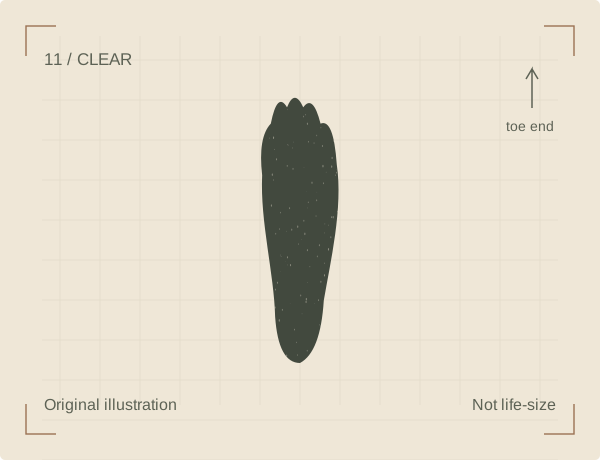
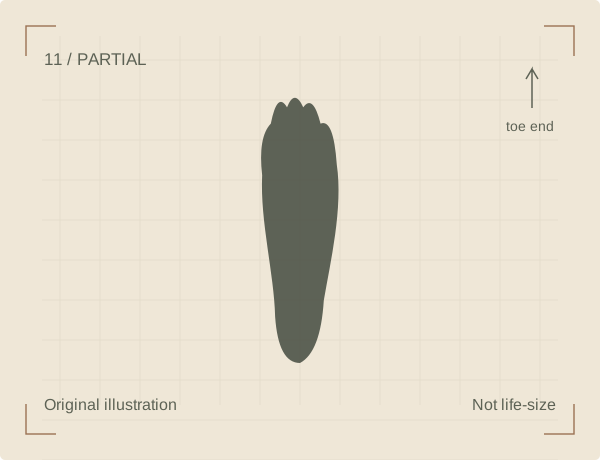
Clear study. Independently enlarged; not life-size.
Read the form
A long hindfoot impression rather than a bare palm.
Toe details can be indistinct in a cottontail impression.
A partial hindfoot may look much shorter.
Hindprint length
7.6–8.9 cm (3–3.5 in)
White Sands desert cottontail length; general toe layout is compared with MDC’s eastern cottontail. Width is illustrative, not a sourced range.
Keep the uncertainty. Rabbit and hare impressions can overlap. A single fuzzy oval is insufficient for species identification.
Partial. The back of the impression is missing. Its remaining length is not the full foot length.Softened. The drawn toe hints become indistinct, leaving a poorly defined oval.
Clear study. Independently enlarged; not life-size.
Read the form
Three long toes extend forward.
A shorter rear toe may leave a small mark.
Toe grooves can remain when surface detail is lost.
Track length example
10.2 cm approx. (4 in approx.)
South Carolina DNR's four-inch diagram is a general reference, not a Bryce range. Width and toe spread are illustrative; the small rear toe need not register.
Keep the uncertainty. Other ground birds make similar three-toed impressions. Missing webbing or a missing rear toe is not a species test.
Partial. Part of one lateral toe and the small rear mark are absent.Softened. The toe grooves widen and their fine boundaries disappear. The bird’s size and identity remain uncertain.
Cover the explanation while considering the alternatives. No answer establishes a field detection.
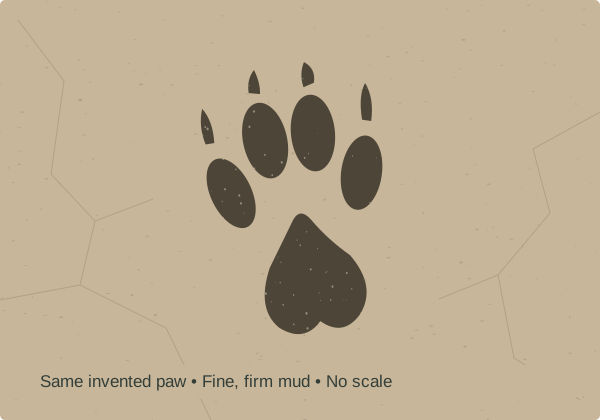
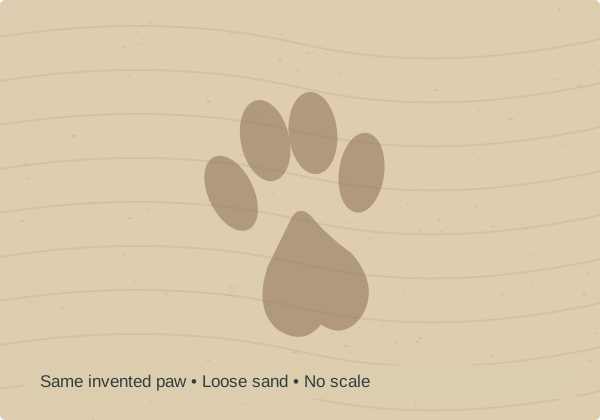
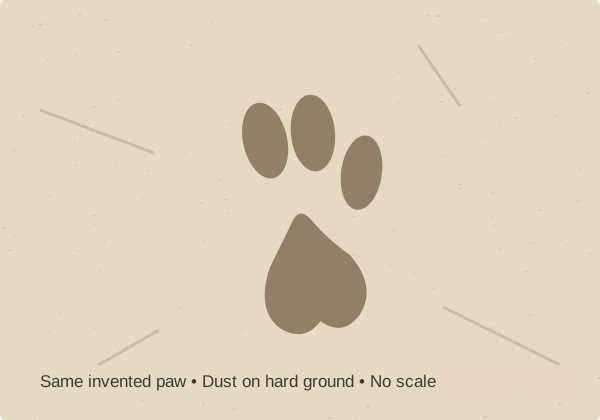
1. A paw without claw marks
Four-toed paw form is suggested, but the outer edge is incomplete and no claws are visible. No trustworthy scale was recorded. This is an invented teaching observation.
Options: Definitely a cat / Definitely a coyote / Unresolved paw print
Supported: Unresolved paw print. Claws can fail to register in a canid print. Missing pad edges and scale make even a confident group match unsafe. The illustrator started with the coyote template; a viewer does not have that ground truth.
2. Two hoof impressions
Two pointed hoof impressions; a made-up measured length of 8.0 cm. No animal was seen. Compare the deer range and pronghorn example.
Supported: Split-hoof form; species unresolved. Eight centimetres falls inside the general adult deer reference and close to the pronghorn example. Shape and size overlap; neither confirms the species. Reference examples are not exclusion limits.
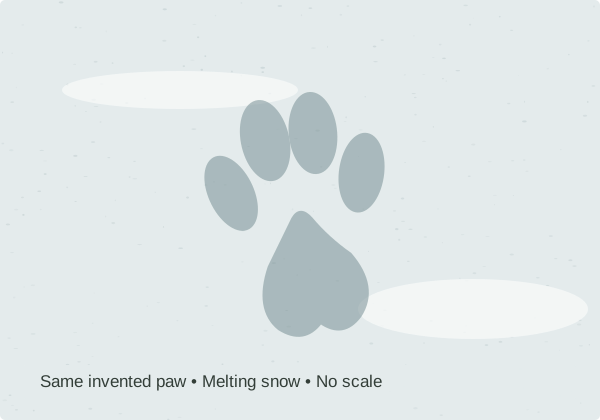
3. A wide depression in snow
A rounded paw-like depression in melting snow appears 12 cm wide in this fictional comparison. Its toe and pad edges are indistinct.
Options: A very large mountain lion / A black bear / Original size and species uncertain
Supported: Original size and species uncertain. Melting can enlarge and merge impressions. A large hollow does not preserve a dependable foot measurement. Neither the species nor a time of passage can be read from it.
4. Count the surviving marks
The original teaching plate has five visible toe marks in front of a broad pad. Select the narrowest statement the drawing supports.
Options: Five toe marks are visible / Only four toe marks are visible / A bear was detected at Bryce
Supported: Five toe marks are visible. Counting five visible marks describes the illustration. It does not turn that illustration into a field detection. Clear evidence supports a clear, limited statement.
REFERENCE REGISTER / ACCESSED 2 OCT 2026
Sources & limits
Original BCC vector artwork, 2026. Source artwork and photographs are not reproduced. All illustrations are educational interpretations. No independent scientist or field observer has certified them.
MammalsNational Park Service, Bryce Canyon · 2025-04-02 · accessed 2 Oct 2026
Park relevance of mule deer, elk, pronghorn, mountain lion, black bear and American badger. Park-level educational list; no current detection, abundance or location is inferred.
Other MammalsNational Park Service, Bryce Canyon · Date not stated · accessed 2 Oct 2026
Park relevance and names of coyote, bobcat and desert cottontail. Presence reference only. No encounter prediction or precise location.
Accepted, approved park record; occurrence Present, abundance Unknown. Legacy park record. It is not a fresh observation or a present-day population estimate.
Other BirdsNational Park Service, Bryce Canyon · Date not stated · accessed 2 Oct 2026
Park relevance and scientific name of wild turkey. No abundance, location or seasonal encounter promise.
General deer, elk and pronghorn dimensions; bear reference dimensions and toe asymmetry; feline pad shape; missing canid claws; substrate-related uncertainty. Regional teaching reference, not Bryce measurements. Pronghorn/bear dimensions are examples, not ranges. Casting, smoothing tracks and collection instructions are excluded from this park kit. Artwork is credited to Jeffery J. Tafoya and is not copied.
Coyote foreprint length 2 1/8–3 1/8 in and width 1 5/8–2 1/2 in (p6); mountain lion 3 1/8–4 in, 2 3/4–4 3/8 in (p13); bobcat 1 1/2–2 1/4 in, 1 5/8–2 3/8 in (p15); four registering toes in canids/felids. Washington reference; sizes are not Bryce-specific. Convert inch values consistently rather than copying rounded or inconsistent metric fractions. Cascade red fox values are not applied to Bryce. Individually credited artwork/photos are not reproduced.
Foreprint 2–2 1/4 in long; four toes; fur-softened pads; central claws often clearer. Missouri reference, not a local size distribution. Original media is copyright protected and not reused.
Front track example 3 1/2 by 2 in; five toes and long foreclaws; heel often absent. Example dimensions only; endpoint convention for claws not specified. Original media is not reused.
Independent check: five toes, small inside toe sometimes absent, front heel pad sometimes absent; size varies substantially. MDC's 3 3/4-in front and 8-in hind length examples differ from NMSU's general examples. They are not averaged into an invented range. Original media is not reused.
Wildlife TracksNational Park Service, White Sands · 2026-03-25 · accessed 2 Oct 2026
Desert cottontail hind impression length 3–3 1/2 in. White Sands reference only. Its coyote front/hind size wording conflicts with the more detailed Rainier/NMSU references and is not used. Images are not reused.
Track MakersNational Park Service, Glacier · 2015-02-24 · accessed 2 Oct 2026
Independent review: deer species cannot reliably be separated from tracks; track and sign teaching context. Glacier context only; no local occurrence or pursuit instructions are imported.
Wildlife TracksNational Park Service, Theodore Roosevelt · Date not stated · accessed 2 Oct 2026
Independent feline pad check: three rear lobes and a leading toe; canid/felid comparison. The page's absolute claim that coyote tracks always show claws is not adopted; NMSU explicitly describes missing claws. No source photograph is reused.
Wild turkey track morphology and Figure 2's four-inch example. General illustration, not a biological size range. No damage-management, pursuit or hunting instructions are included. Figure 2 is credited to Dee Ebbeka and is not copied.
Leave wildlife space; do not feed or approach; observe without changing behavior. The kit offers no directions to an animal, den or nest. Consult current park guidance independently.
General cottontail comparison: elongated hind impression; four indistinct toes. Eastern cottontail is a different species. Used only as a general anatomical comparison, not for desert cottontail dimensions or park occurrence. Artwork not copied.