03 / Teaching guide · Geology · 40 minutes
Two histories in one landscape
Is the age of the rock the age of the shape?
Suggested ages 11–16. Ages and timings are editorial suggestions; adapt to your learners.
Prepare & connect
Open Deep Time and choose Read all chapters, or use these plates. Supply paper strips and a pencil. Introduce sediment, lithification, uplift and erosion. No particular numerical date must be memorised; the task is to reason about relationships.
Optional local resource: Deep Time at Bryce. Choose Read all chapters. No terrain viewer or animation is needed.
- 5 minPose two questionsWrite ‘When did the rock form?’ beside ‘When did this shape form?’ Ask whether one answer could automatically answer both. Keep the questions visible throughout the lesson.
- 15 minRead six chaptersRead Sediment, Rock, Uplift, Weathering, Hoodoos and Today. Assign one chapter to each pair if needed. Each pair names a process and reports a limitation printed beside the illustration.
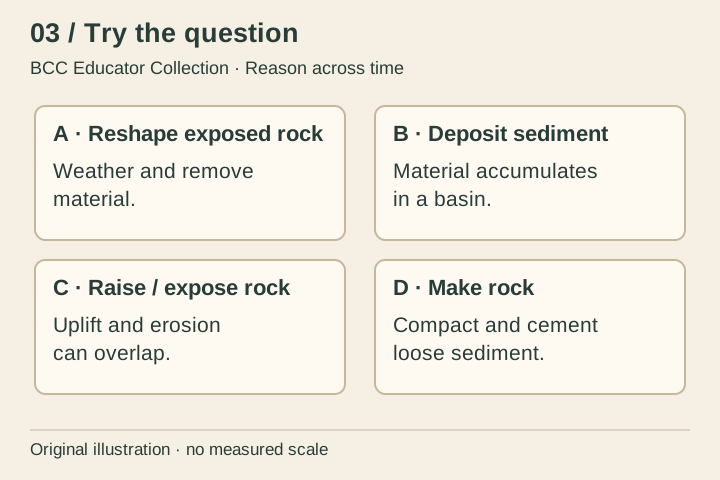
- 15 minOrder and connectArrange the four activity cards. Draw arrows showing the dependencies your group proposes. Add an overlap bracket where raising and uncovering rock might proceed together. Mark the sequence as a conceptual account rather than four dated episodes.
- 5 minCheck the clockA reader spends ten seconds on each card. Ask whether that makes the processes equally long. Write a caption that prevents this misunderstanding.
The intended conceptual order is deposit sediment, make rock, raise/expose rock, then reshape exposed rock. Accept discussion of overlapping uplift and erosion and of continuing deposition elsewhere. Equal cards do not imply equal durations. No exact hoodoo age follows from this exercise.
Access: Use numbered text cards or a spoken sequence. Motion is unnecessary; the linked reading mode and every plate are static.
03 / Read the evidence · Learner sheet
Two histories in one landscape
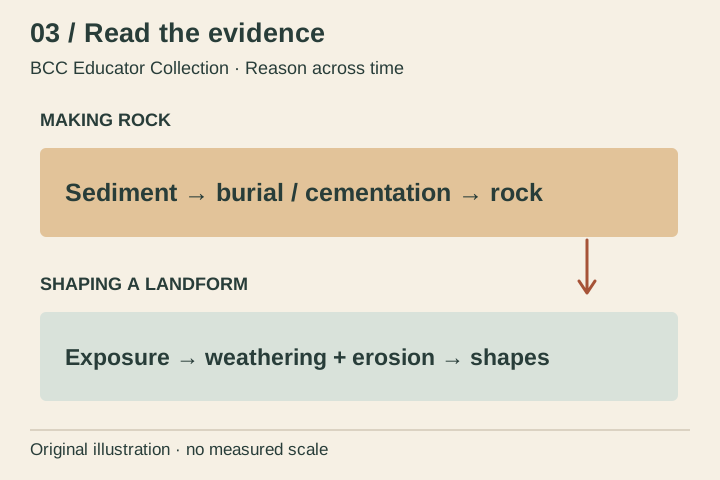
Sediment can become rock through processes including compaction and cementation. Later exposure, weathering and erosion reshape rock into landforms. A landscape therefore holds several histories at once. Our sequence simplifies their relationships; its spacing, arrows and panel size contain no numerical time information.
Look closely
- Which card concerns making rock? Which concerns changing an exposed shape?
- Which processes can overlap rather than starting and stopping at neat boundaries?
- What independent dating evidence would be needed to put numbers on this account?
Evidence limit: Conceptual process order, not a calibrated timeline or reconstruction of an ancient shoreline. No dates inferred from artwork.
Reading behind the lesson
- National Park Service · Bryce Canyon · Hoodoos · 2021-09-04.
- National Park Service · Geology · Sedimentary Rocks · 2024-07-08.
- Copied integrated BCC experiences and source registers · 2026-10-02 snapshot.
03 / Try the question · Learner sheet
Reason across time
Read the shuffled cards, propose an order and explain two of your arrows. Use an overlap bracket when appropriate. Write one sentence answering the question about rock age versus shape age without inventing a date for a named hoodoo.
Take it further: Compare the source notes for an introductory age statement with a local mapped unit. Explain why a broad regional age range need not date every bed at Bryce.
Success looks like: Explain why an animation duration is not an elapsed geological time.
All lessons and plates are included in this local copy. Linked experiences are optional. No learner names, responses or locations are collected by this collection.
Save summary plate (SVG) · Save activity plate (SVG)