05 / Teaching guide · Living Bryce · 35 minutes
A tree is more than a silhouette
Which observations would make a tree identification more convincing?
Suggested ages 10–14. Ages and timings are editorial suggestions; adapt to your learners.
Prepare & connect
Use the two conifer entries in Living Bryce or the summary plate. Provide paper and pencil. Explain fascicle as a bundle of needles. This is an indoor comparison: learners do not collect needles, approach wildlife or record personal locations.
Optional local resource: Living Bryce · compare conifers. Use the two conifer cards and comparison selectors. The separate checklist is not needed for this activity.
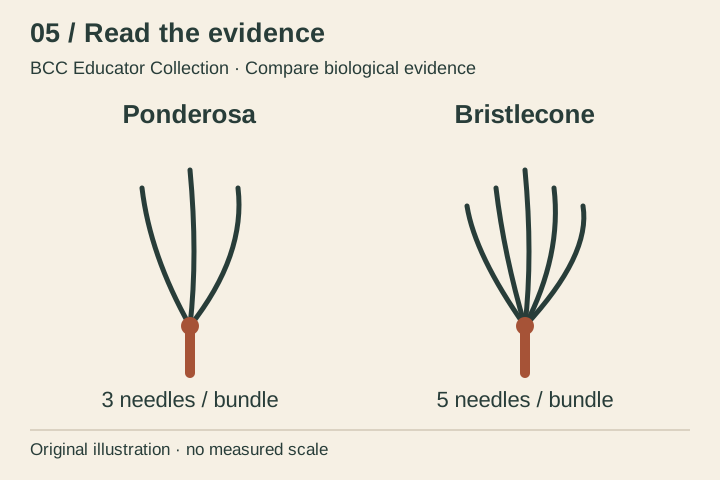
- 5 minNotice the bundlesCount the drawn needles. Explain that the drawing illustrates a published description and is not a branch collected or photographed in the park.
- 15 minCompare recordsChoose ponderosa pine and Great Basin bristlecone pine in Living Bryce’s comparison. Look at needle description, bark or branch traits and habitat. Discuss why habitat narrows a question without proving the identity of an individual.
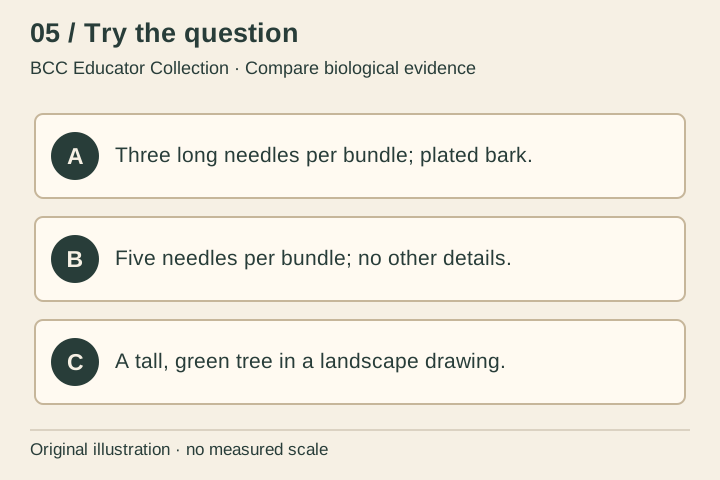
- 10 minReason with incomplete casesRead the three fictional evidence cases on the activity plate. For each, say which description it is consistent with and what remains unresolved. A five-needle bundle alone does not exclude other pines.
- 5 minExit with uncertaintyWrite a qualified identification statement. Include one additional non-destructive observation you would want before becoming more confident.
A is consistent with the ponderosa description, but not proof. B is compatible with the bristlecone description and with other five-needle pines; more traits are needed. C supplies too little information. None includes an independently documented field observation. Tree shape alone is weak evidence.
Access: Counts and species names appear in text. Enlarge the standalone SVG or use the written cases; an oral comparison works without colour or fine visual detail.
05 / Read the evidence · Learner sheet
A tree is more than a silhouette
The NPS description of ponderosa includes three long needles per bundle and plated bark in mature trees. Its Great Basin bristlecone entry describes five needles per bundle. These are useful comparison traits, not a complete identification key. A source describing a species in the park is different from evidence that someone observed a particular tree.
Look closely
- Which trait is a count, and which description depends on the age or part of a tree?
- Could another species share one of these traits? What would you check next?
- Which information would turn a general habitat description into a documented observation?
Evidence limit: Original trait diagrams, not botanical specimens, photographs, a complete key or evidence of any current tree occurrence.
Reading behind the lesson
- National Park Service · Bryce Canyon · Ponderosa Pine · 2015-02-24.
- National Park Service · Bryce Canyon · Great Basin Bristlecone Pine · 2024-03-05.
- Copied integrated BCC experiences and source registers · 2026-10-02 snapshot.
05 / Try the question · Learner sheet
Compare biological evidence
Classify each fictional case as consistent with a description, insufficient evidence, or a documented sighting. Explain the decision. None of the cases is a verified sighting. Do not use this worksheet to publish exact locations of sensitive individuals.
Take it further: Add limber pine from the integrated guide. Does including another five-needle species change your confidence in Case B? Explain why.
Success looks like: Use uncertain or insufficient evidence as a useful result.
All lessons and plates are included in this local copy. Linked experiences are optional. No learner names, responses or locations are collected by this collection.
Save summary plate (SVG) · Save activity plate (SVG)