01 / Teaching guide · Geology · 35 minutes
How a wall becomes a wonder
What changes the rock, and what carries the pieces away?
Suggested ages 10–14. Ages and timings are editorial suggestions; adapt to your learners.
Prepare & connect
Allow five minutes to read both plates. Bring paper and a pencil; a shared screen is optional. Introduce fracture (a break), weathering (breakdown) and erosion (transport). No rock collection or physical freezing experiment is required.
Optional local resource: Weathering Lab. JavaScript for controls; use Reading the model or this bundle without it.
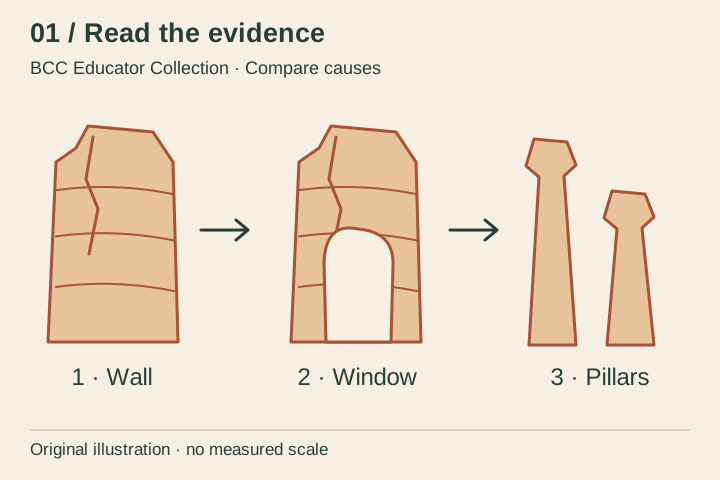
- 5 minNotice before namingShow the summary plate. Ask pairs to describe shapes and gaps using only what is drawn. Then name wall, window and pillar. Ask what the spaces between these snapshots leave unknown.
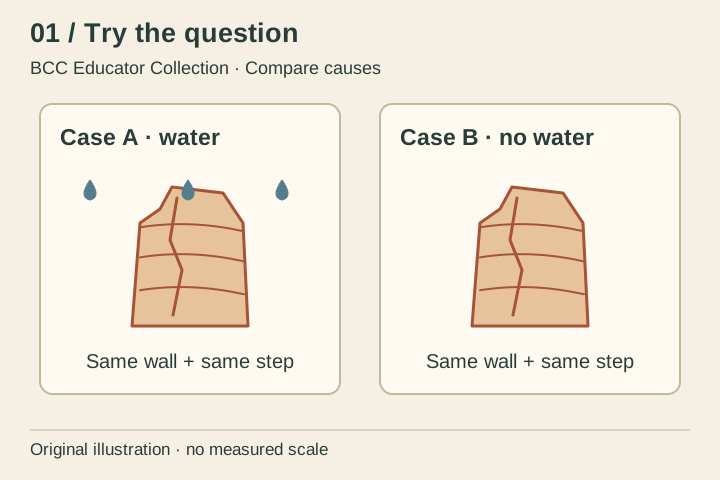
- 15 minMake a fair comparisonIn Weathering Lab, choose Water, frost & varied beds, then set Model steps to 36. Record the wall seed and settings. Choose Take water away without using New wall; leave the step at 36. Compare reference A with experiment B. If offline, predict a difference between the two cases on the activity plate; label it a prediction.
- 10 minTrace the materialFor each change, ask whether rock broke down or moved. Draw an arrow only where your explanation involves transport. Describe how a window could lose its span without claiming that every wall follows this exact path.
- 5 minExit claimComplete: In this model, changing ___ affected ___. This does not tell us ___. Use a control or a specific part of a plate as evidence.
Look for a controlled comparison and an explicit separation of breakdown from transport. A drawing alone cannot establish speed or predict the future of a named hoodoo. Accept ‘not tested’ when the interactive resource is unavailable.
Access: Read the plate descriptions aloud; learners may dictate a claim or point to a numbered stage. All meaning is also written outside the diagram.
01 / Read the evidence · Learner sheet
How a wall becomes a wonder
Water, fractures and differences in rock resistance help shape the landscape. Weathering changes or breaks rock in place; erosion moves material. Fins, windows and isolated pillars provide a useful conceptual sequence. The summary plate is an original diagram, not observations of one rock through time.
Look closely
- Where can you point to a change in the shape? Where would removed material need to go?
- Which control did you change? Which settings and comparison step stayed the same?
- What evidence would you need before converting model steps to years?
Evidence limit: Illustrative rules and invented geometry; no erosion rate, weather forecast, measured hoodoo history or ground-level scan.
Reading behind the lesson
- National Park Service · Bryce Canyon · Hoodoos · 2021-09-04.
- National Park Service · Bryce Canyon · Wall and Narrows · 2021-09-04.
- National Park Service · Bryce Canyon · Arches · 2015-02-24.
- Copied integrated BCC experiences and source registers · 2026-10-02 snapshot.
01 / Try the question · Learner sheet
Compare causes
Use the two-case frame to design a comparison. Name one changed variable, two controls and an observable outcome. Write a prediction before using the model, then compare it with the result. Keep the offline prediction distinct from a result you actually observed.
Take it further: Compare equal resistance with varied resistance while holding water and fracture spacing steady. Does your first explanation still account for the shapes?
Success looks like: Write a claim that stays within the evidence of a simulation.
All lessons and plates are included in this local copy. Linked experiences are optional. No learner names, responses or locations are collected by this collection.
Save summary plate (SVG) · Save activity plate (SVG)