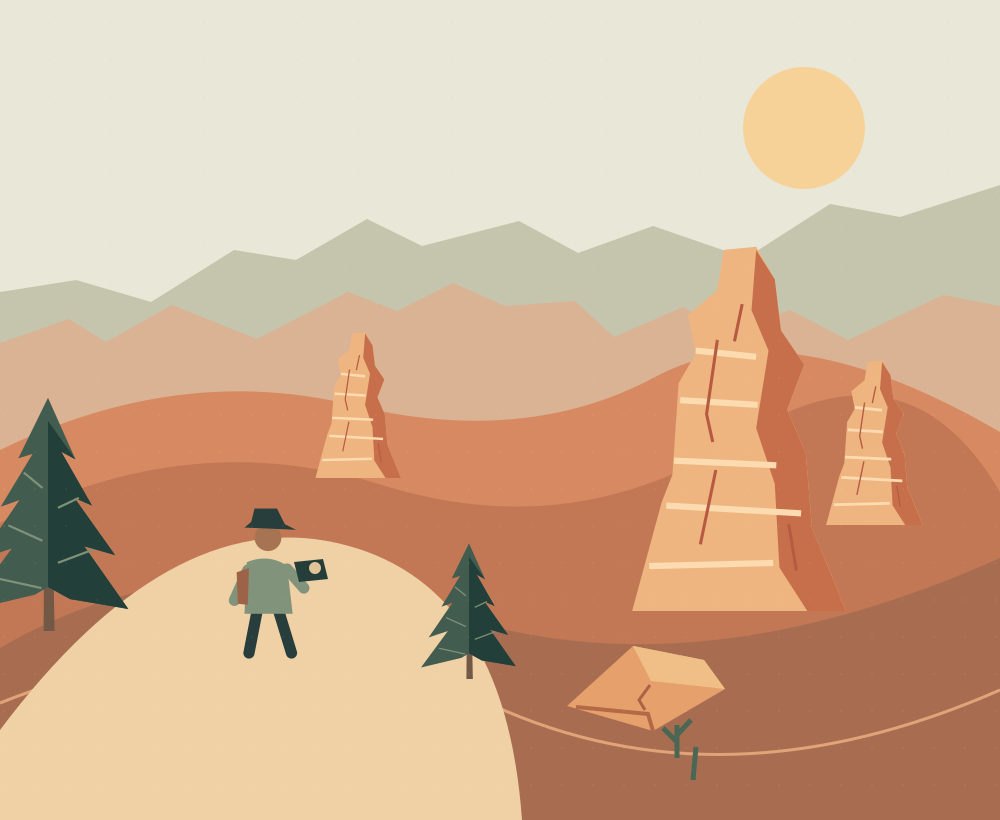
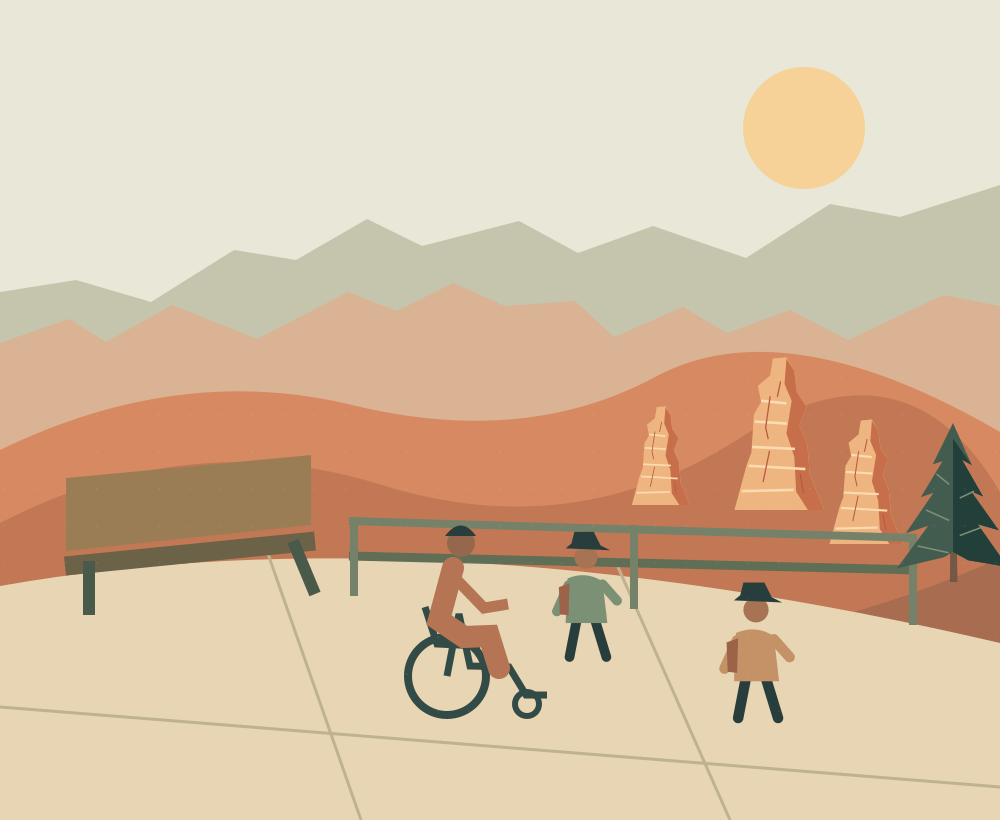
Eight imagined teaching stories. All choices and explanations are available here without JavaScript. The original scenes are illustrative, not measured views or records of incidents.
01 / Trails
The tempting shortcut
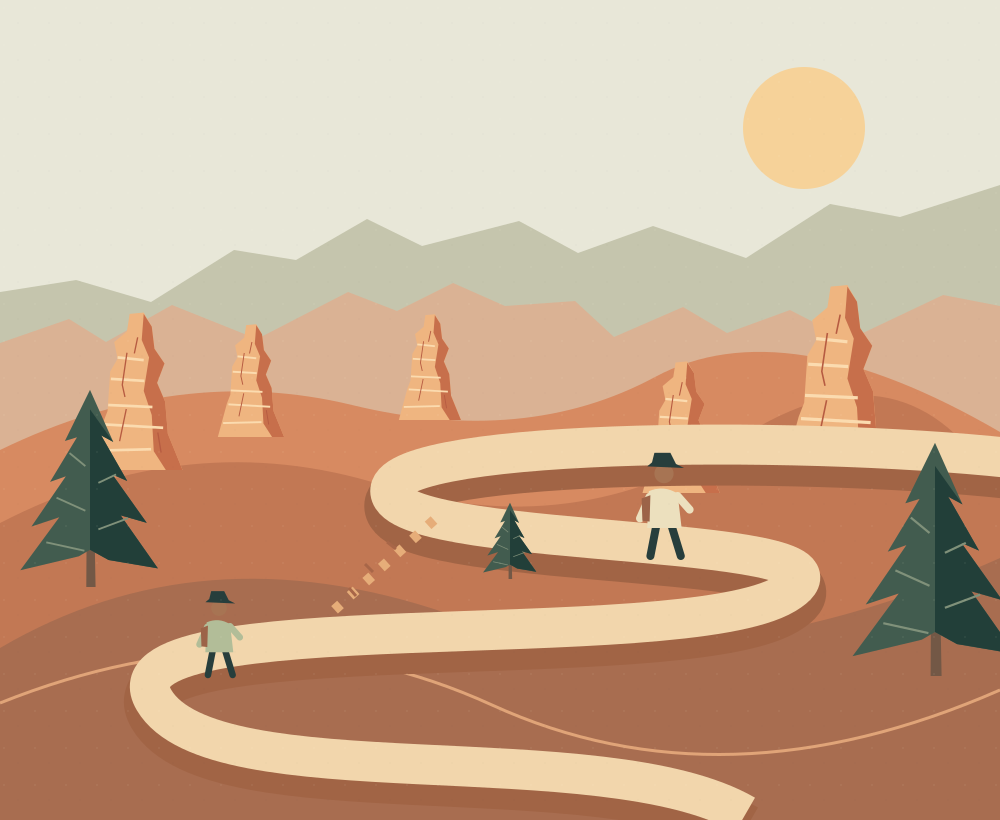
Original illustration · invented forms, no measured scale
Imagine a quiet bend on a Bryce trail. The next switchback is visible below you. A worn diagonal seems to cut out the turn. Your friend says, “It is only a few steps.”
Notice: A line of footprints is not the same as a designated trail.
Which way do you go?
Choice A: Take the diagonal; it is already worn.
A worn line can keep growing. NPS asks visitors to avoid social trails because they damage plants and contribute to erosion. Existing footprints do not show that a route is designated.
Then: Before leaving the trail, your friend pauses. What now?
Keep to the bend together.
A small course correction. You can change the plan before taking the shortcut. Continue on the designated trail and let the slope stay outside the route.
Follow it carefully, single file.
Careful footsteps still leave the trail. Walking slowly does not make the diagonal a designated route. Reconsider the shortcut and use the trail instead.
Choice B: Stay with the switchback.
The bend is part of the route. This follows Bryce’s guidance to stay on designated trails. The view of another turn does not make the ground between them a walking route.
Then: Your friend is falling behind. Where do you regroup?
At a suitable wider place on the trail.
Keep the group on the route. Wait where the trail provides room without blocking others. Do not turn the slope into a meeting place.
On the slope inside the bend.
The pause matters, too. A rest stop can create the same off-trail pressure as a shortcut. Look for room on the designated route instead.
Choice C: Stop and check the park map.
Check before committing. A park map or a ranger can help clarify the intended route. A faint mark on the ground is not enough evidence by itself.
Then: The diagonal is not shown as part of your route. What is your next step?
Use the marked trail; ask if still unsure.
Let uncertainty slow the decision. Keep to established access while you clarify the route. A shorter-looking line does not need to become an experiment.
Assume the map left out a shortcut.
An assumption is not a route check. Do not use a missing map line as permission to cross the slope. Stay on the designated trail and seek clarification.
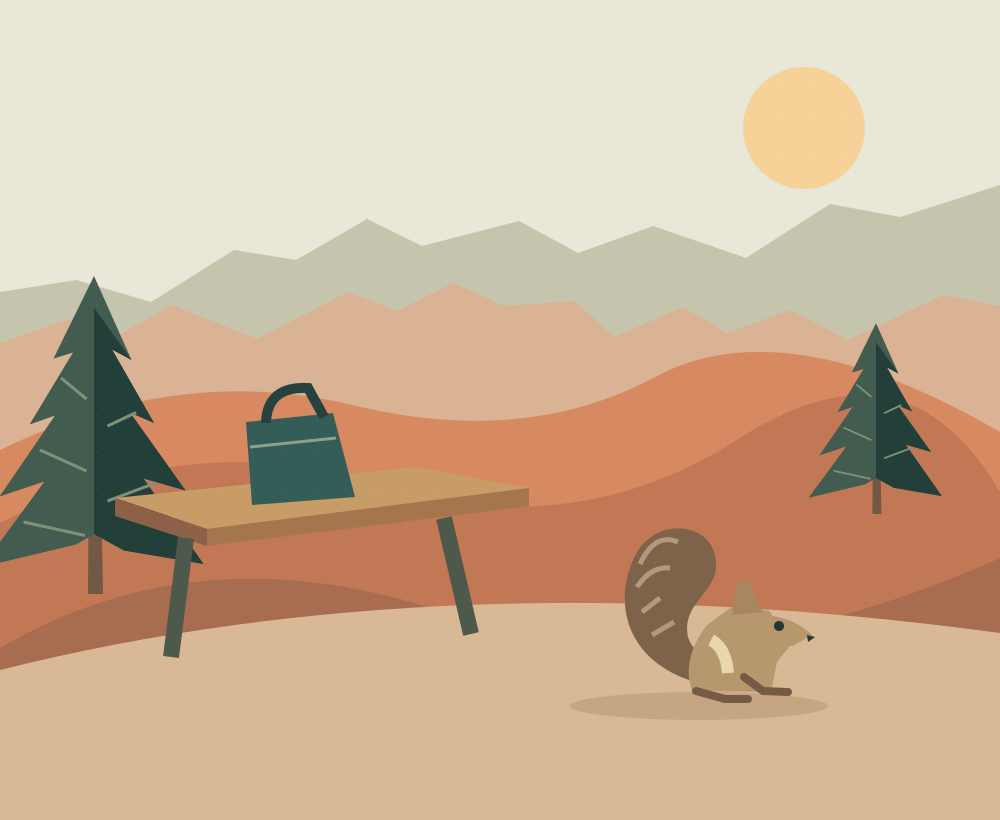
Original illustration · invented forms, no measured scale
Imagine finishing lunch at a picnic area. A squirrel comes toward your table. You have a few crumbs and a phone within reach.
Notice: An animal approaching people is a reason to give it room, not an invitation.
What do you do with the last crumbs?
Choice A: Offer a tiny crumb for a photo.
Small food is still food. NPS explains that crumbs can attract wildlife and teach animals to seek food from people. The size of the offering does not change that relationship.
Then: The camera is ready, but the crumb is still in your hand. What next?
Put the food away and give the animal room.
Keep the encounter on its terms. Secure the food, stay back, and let the animal move freely. A zoomed view can be enough.
Hold the crumb farther from the camera.
Moving the lure does not remove it. The food is still being used to attract the animal. Put it away instead of arranging the encounter.
Choice B: Secure the crumbs with the rest of lunch.
Remove the invitation. Keeping food and waste contained follows NPS wildlife guidance. It also keeps the photograph from depending on a food reward.
Then: The squirrel comes closer anyway. How do you respond?
Give it more space without approaching it.
Let distance do the work. NPS recommends moving back when wildlife approaches. If an animal keeps approaching people, let a ranger know.
Reach down so it can investigate your hand.
A close encounter can be too close. Do not touch or invite contact. Keep your hands to yourself and give the animal room.
Choice C: Brush the crumbs onto the ground.
Out of sight is still available. Scraps on the ground can attract an animal just as food on a table can. NPS recommends keeping picnic areas clean and using proper waste containers.
Then: You notice a few crumbs still on the table. What is the better next step?
Collect those crumbs and secure all remaining food.
Finish the cleanup. Contain the scraps for proper disposal. Keep food waste out of reach instead of moving it to another surface.
Leave the rest as a natural snack.
Human scraps are not part of the plan. Food that seems ordinary to us can still encourage wildlife to seek people. Collect and contain the remaining scraps.
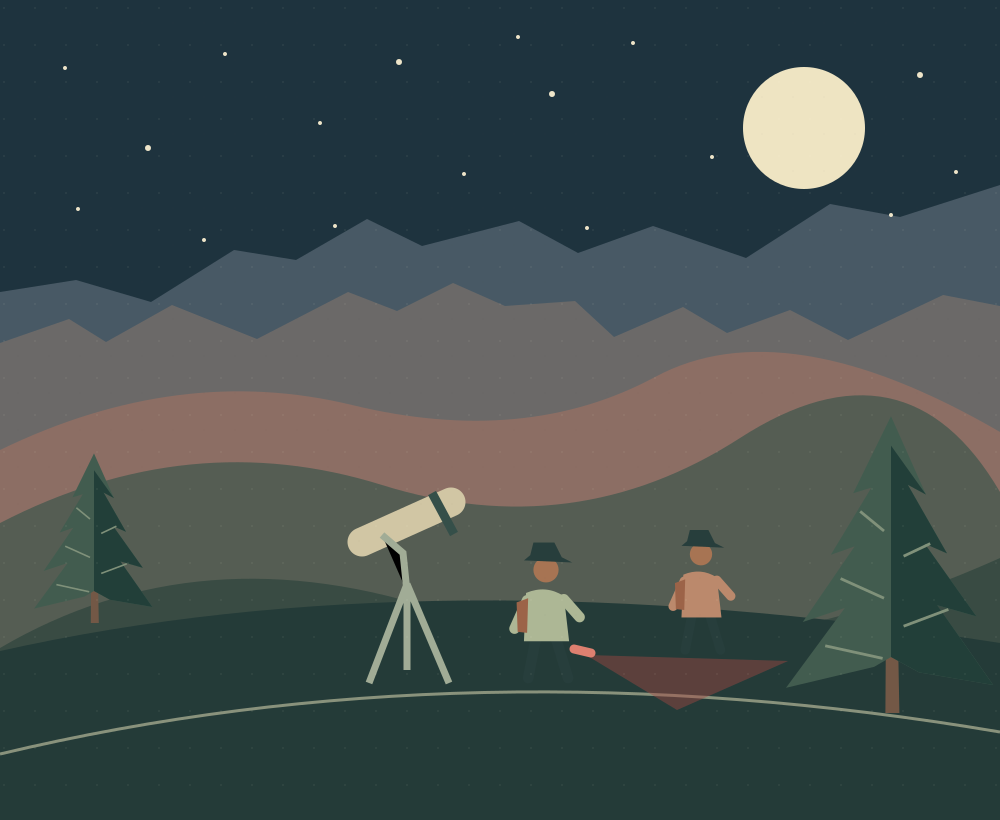
Original illustration · invented forms, no measured scale
Imagine an independent evening of stargazing at an open viewing area. People nearby are looking up. You need a light to find the zipper on your bag.
Notice: Where a light points matters, as well as its color.
How do you use your light?
Choice A: Use a low red light, aimed at the bag.
Light for the task. NPS recommends red light to help preserve night vision. Keeping the beam on the task is a considerate application of that guidance.
Then: You have found the zipper. What now?
Switch it off when the task is finished.
Let the shared darkness return. Keep the light available for when it is needed again. Darkness is part of what everyone came to experience.
Leave it shining toward the next group.
Red is not a reason to shine at people. Aim the light away from others and use it only as needed. This is about the direction and amount of light, too.
Choice B: Sweep a bright white beam across the area.
The beam reaches other eyes. NPS notes that white light affects night vision. A wide sweep also brings your task into everyone else’s view.
Then: You notice someone shield their eyes. How do you adjust?
Lower the beam and use a dimmer setting if sufficient.
Make the adjustment small and useful. Direct enough light at your task, away from other people. Use a red setting if available and suitable.
Keep sweeping because it will only take a moment.
Brief light still reaches the group. Pause the sweep and aim the light where it is needed. A short task can use a narrow, considerate beam.
Choice C: Keep it off even though you cannot see your footing.
Darkness is not the only consideration. NPS night-sky advice keeps a light available for safety. Protecting the viewing experience does not require moving when you cannot see your way.
Then: You need to move a few steps. What helps?
Stop, light the ground sufficiently, and then move.
See the next step. Use enough light for safe movement and direct it away from other observers. Follow any specific staff instructions.
Feel your way forward without enough light.
Do not trade footing for darkness. Pause and use sufficient light before moving. This imagined stargazing scene is not a ranger-led full moon hike.
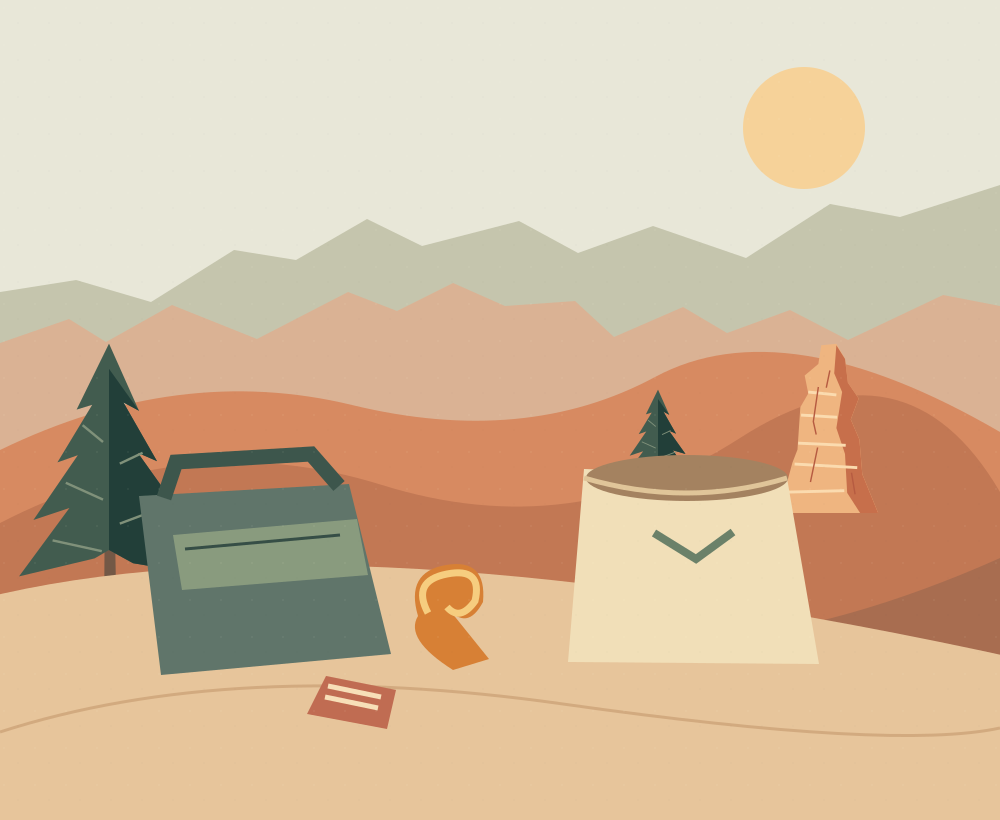
Original illustration · invented forms, no measured scale
Imagine a snack stop. Your orange is finished, the nearest trash container is elsewhere, and an empty pocket in your bag could hold the peel.
Notice: A food scrap is something you brought with you.
Where does the peel go?
Choice A: Tuck it under a bush; it will break down.
Hidden scraps are still scraps. NPS Leave No Trace guidance includes leftover food in what visitors should pack out. No decomposition time is needed to make that choice.
Then: Before putting it down, you spot an empty pouch. What do you do?
Use the pouch and carry the peel out.
Make room for the small things. Contain the peel with your other food waste until you reach an appropriate trash container.
Leave it because it came from a plant.
Its origin does not decide its place. A peel brought for lunch is still leftover food. Carry it out with you.
Choice B: Put it in the pouch for later disposal.
A pocket-sized solution. This follows the guidance to pack out food scraps. A bag or container keeps the task manageable for the rest of the walk.
Then: A breeze catches a clean wrapper at your feet, within easy reach on the trail. What next?
Secure it with the rest of your litter.
Keep loose pieces contained. Collect the ordinary wrapper without leaving the trail, then close the pouch so the contents stay with you.
Leave your pouch open while you walk.
Containment is part of carrying it out. Close the pouch so loose packaging stays inside. An open bag makes the cleanup less secure.
Choice C: Set it beside the trail to collect on the return.
A plan to return leaves food unattended. NPS asks visitors to carry out food scraps and keep wildlife from accessing food waste. Keeping it with you avoids depending on a later pickup.
Then: Your route plans might change. What is the simplest adjustment?
Take the peel with you now.
Finish the task in one step. Carry it in your bag and dispose of it properly when a suitable container is available.
Hide it behind a rock so you will remember.
A hiding place is not a container. Keep the peel with you instead. Do not rearrange natural objects to mark a litter pickup.
Original illustration · invented forms, no measured scale
Imagine lining up a photograph from the trail. A low rock ledge just beyond the path would give you a cleaner view. Its surface looks solid from here.
Notice: A convincing-looking surface is not a tested foothold.
How do you find the picture?
Choice A: Step onto the ledge for a higher angle.
Looks alone cannot carry the decision. Bryce’s NPS safety guidance describes crumbly rock and warns against climbing and leaving designated trails. A small ledge is not established access.
Then: Before stepping off, you reconsider the frame. What now?
Compose from the trail instead.
Change the frame, keep the footing. Try a different crop or viewpoint along the designated path. The rock does not need to become a platform.
Test the ledge by kicking or pulling at it.
A test can disturb the thing you came to see. Do not use this as a way to approve a foothold. Stay on the trail and leave the rock undisturbed.
Choice B: Find a new composition from the path.
The picture can adapt. Staying on the designated route follows park guidance. A crop, a different focal length or simply another view can become part of the creative choice.
Then: Someone passes behind you. How do you make room?
Pause at a wider established spot.
Share the path and the view. Let people pass where the path provides room. Keep yourself and your equipment within the established surface.
Move the tripod onto the plants beside the path.
Equipment has a footprint, too. Make room within the established surface, or pack the tripod while others pass. The plants are not extra floor space.
Choice C: Ask a friend to stand on the ledge for scale.
The invitation moves the same problem. The guidance about staying on trail and off crumbly rock applies to the subject of the picture as well as the photographer.
Then: Your friend suggests a different portrait. Which arrangement works?
Photograph them from a suitable place on the trail.
Keep both people on established access. Use the trail as part of the composition and avoid obstructing other visitors.
Have them climb only a little way.
A shorter climb is still a climb. Keep the portrait on designated access. This story does not establish a safe height or a suitable climbing surface.
Original illustration · invented forms, no measured scale
Imagine your group arriving at a broad overlook. Someone is listening quietly, another visitor is moving through, and a friend suggests playing a song on a speaker.
Notice: Other visitors may be here to hear something you have not noticed.
How do you set the mood?
Choice A: Play the song softly for the group.
Quiet music still enters shared space. Bryce’s hiking guidance asks visitors to keep noise low and refrain from playing music aloud. A low volume does not make the sound private.
Then: The group wants a memory of this moment. What could you suggest?
Save the song for later and listen together now.
Make room for the sounds already here. A shared pause or a photograph can mark the moment without adding amplified sound.
Turn it up so everyone in the group can hear.
The audience grows beyond the group. Keep the speaker off. Other visitors have not chosen the soundtrack.
Choice B: Keep the speaker off and listen.
There is already something to hear. This follows NPS guidance on natural quiet and consideration for other visitors. It leaves room for many ways of enjoying the same place.
Then: Your group spreads across the path. What next?
Gather where the established surface leaves passing room.
Leave an opening in the moment. Keep a clear route for other people. A good gathering spot has room for the group and for passing visitors.
Ask everyone else to wait until your group is done.
The view is shared. Avoid turning the whole passing space into a private stop. Regroup where the existing surface provides room.
Choice C: Call out to make the canyon answer.
An echo has listeners, too. NPS asks visitors to keep noise low. Calling into the landscape adds sound beyond the immediate group.
Then: You decide to try a different listening activity. What is it?
Pause and notice the sounds already present.
Let listening be the activity. Compare what each person notices without needing to produce a louder sound.
Take turns shouting, one person at a time.
Taking turns does not make it quieter. Choose a quieter way to share the place. The order of the calls does not remove their effect on other listeners.
Original illustration · invented forms, no measured scale
Imagine noticing a small stone beside the trail. Its bands catch your eye. You would like to remember it after you leave.
Notice: The place where an object rests is part of what you are observing.
What do you take away?
Choice A: Put the stone in your pocket.
Small objects still belong to the place. NPS encourages visitors to leave natural objects for others to discover. A small size is not a reason to remove one.
Then: Before picking it up, you notice your notebook. Which memory will you keep?
Sketch the pattern and leave the stone.
Carry the observation. Record its colors and pattern from the trail. You can leave its identity uncertain and still make a careful note.
Take it now and bring it back on another trip.
A future return does not keep it here today. Leave it in place now. A photograph or drawing can travel with you without removing the find.
Choice B: Photograph it where it lies.
Keep the setting in the story. NPS suggests photography and nature journals as ways to remember finds while leaving them in place.
Then: A leaf partly covers the stone. How do you respond?
Include the leaf or change the framing from the trail.
The arrangement is part of the observation. Let the scene be as you found it. You do not need a perfectly isolated specimen to make a useful record.
Rearrange the objects to make a display.
Observation does not need a new arrangement. Leave natural objects where they are. Change the picture rather than assembling the find.
Choice C: Stack it with other stones as a marker.
A keepsake does not need to stay as a structure. Leaving objects as found includes their arrangement. This scene is not an official trail-marker task.
Then: Your group wants to remember the spot. What would help?
Write a note without moving anything.
Make the record in your notebook. Describe what you saw from established access. Do not add a marker or dismantle a marker you did not place.
Build a taller stack so it is easy to spot.
Visibility is not a reason to rearrange. Keep the stones in place and use your own notes. Do not treat this illustration as guidance to modify trail markers.
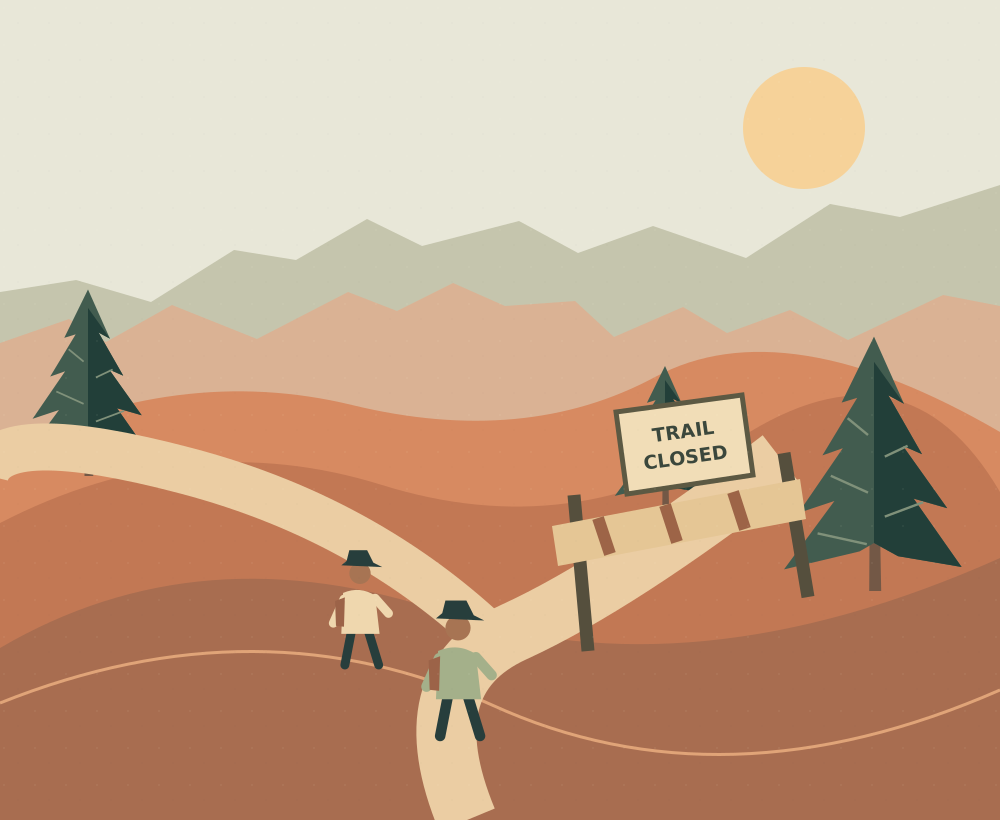
Original illustration · invented forms, no measured scale
Imagine reaching a junction where a posted sign closes the route you planned. Your saved screenshot shows the route as open. This is a fictional situation, not a report of a current closure.
Notice: A saved plan cannot tell you what changed after it was made.
Which information guides your next step?
Choice A: Follow the saved screenshot past the sign.
The saved plan has a date. NPS directs hikers to check current conditions for closures. A screenshot cannot override what is posted at the route.
Then: Before passing the sign, your group stops. What now?
Use established open access and check with staff.
Update the plan, not the sign. Stay out of the closed route while you clarify the information. Choose an open alternative that suits the group.
Go a little farther to inspect the reason.
A closure is not a viewing invitation. You do not need to enter the closed route to verify a hazard. Remain outside and ask park staff.
Choice B: Respect the sign and rethink the route.
Leave space for new information. A change of plan is a reasonable response to a closure. NPS’s conditions page is a starting point; on-site notices and staff add context.
Then: There is no connection on your phone. How do you decide?
Return by established open access and ask staff.
Uncertainty can wait. Do not improvise a bypass. A shorter visit or a different open destination can still be a good plan.
Walk around the sign because the website will not load.
No signal does not change the sign. Keep the closure in effect in your planning until you can clarify it. Use established open access.
Choice C: Look for footprints around the barrier.
Other footsteps cannot verify access. A route used by someone else is not evidence that a posted closure has changed. Check park information rather than an informal bypass.
Then: The footprints continue out of sight. What is the next useful step?
Stay outside the closure and choose an open route.
Make the decision at the sign. Follow established open access and ask staff if the route status is unclear.
Follow the footprints until they meet the trail.
An unseen connection is an assumption. Do not use an off-trail bypass to get around a closure. Return to your open route options.
Primary sources checked 2 October 2026. Dates below are page update dates, not promises about current conditions. Visit the official pages again before a trip. The fictional closure story describes no specific trail or current closure.
The factual principles are paraphrased from NPS guidance; the situations, branch dialogue, discussion questions, compositions and SVG artwork are original BCC teaching material. Suggested applications, such as directing a light at a bag or regrouping at a wider established surface, are educational judgments. They are not predictions of an outcome, NPS-approved scripts or incident records.
Night-light guidance here is for independent stargazing. Check the instructions for a specific ranger program; Bryce’s full moon hikes have different flashlight rules. This pack gives no measured wildlife distances, identification, erosion rates, recovery times, legal interpretations or medical advice.
Hiking · Bryce Canyon National Park · page updated October 11, 2024
Your Safety · Bryce Canyon National Park · page updated October 11, 2024
Current Conditions · Bryce Canyon National Park · page updated August 31, 2026
No external photographs, source diagrams or agency marks are reused. “Leave No Trace” principles are credited by NPS to the Leave No Trace organization; no associated logo or full principles text is reproduced here. See the asset and typography notice and the machine-readable source ledger.
Independent of the National Park Service. No affiliation or endorsement implied.