Town streetlights
Grants for fully shielded, warm or amber streetlights and lights on town buildings, put in by the power company or a licensed electrician.

Weather unavailable
Observed at Bryce Canyon Airport. Conditions at the rim can differ.
NWS · KBCE airport · time unavailable
Forecast unavailable. Use the NWS source below.
Forecast issue time unavailable
Park updates unavailable
Check NPS for the latest closures and conditions.
We plan to help Tropic replace exposed outdoor lights with shielded, warm lighting, starting near wildlife habitat. Cannonville and Bryce Canyon City could follow.
Planned As of October 6, 2026: plan and research written. No town contacted; nothing funded or installed.
Utah’s wildlife agency maps Bryce Valley as mule deer winter range, so deer are near these towns in the longest nights of the year. A migration route of the Boulder deer herd, about 7,000 animals, reaches the valley near Tropic.
Bryce Canyon lists 14 kinds of bat. Seven are Myotis, a group known to avoid light. The park’s own sky measurements found its night sky influenced by the lights of neighboring towns, Tropic among them.
Shielding and warmer light also keep glare out of neighbors’ windows and keep more stars visible over town.
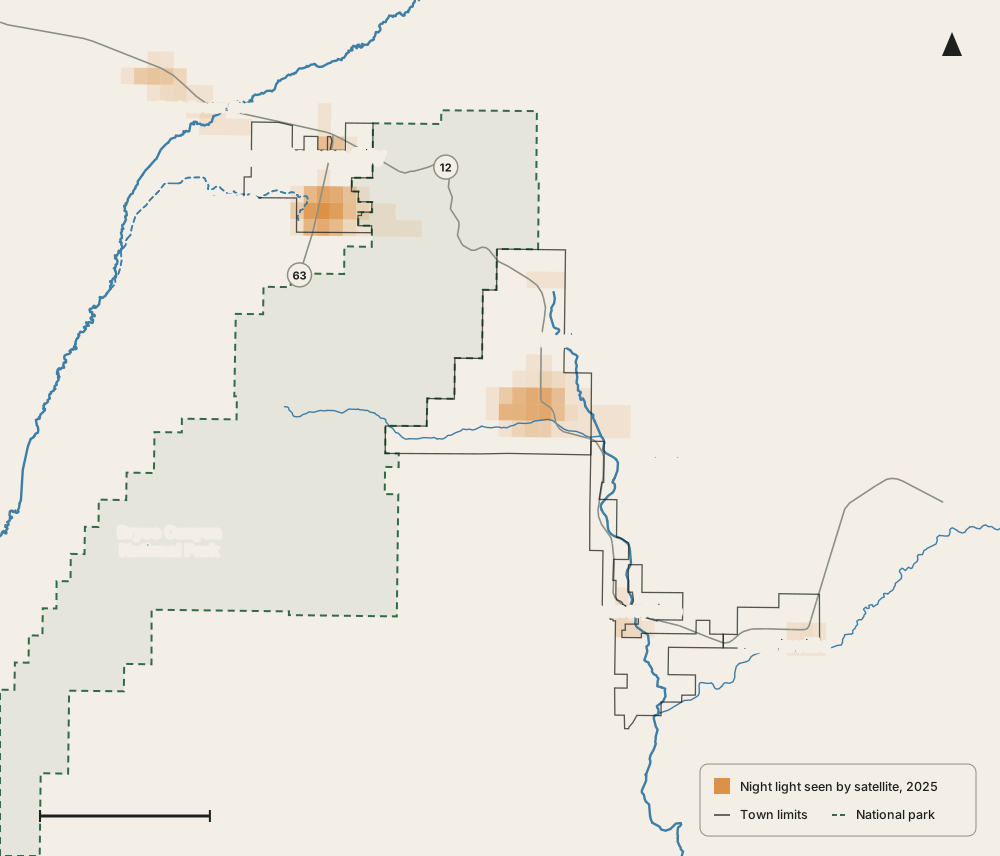
 Derived Where Bryce Valley’s lights are. Orange squares are NASA satellite measurements of night light (Black Marble, May to October 2025, about 400 m across); town limits from Utah’s geographic office; park boundary from the National Park Service. Wildlife ranges are not drawn here: see the state’s habitat maps and USGS (2024), figure 19.
Studies of light at night, the animals that live here, and how strong the evidence is for each.
| Animals and plants, and evidence | What studies found |
|---|---|
| Bats Strong | Light-shy bats such as the little brown myotis avoided white LED light even 75 m away, at less than 1 lux (Seewagen and others, 2023). Avoidance reached 50 m from streetlights, and the authors recommend keeping streetlights at least 50 m from wildlife corridors (Azam and others, 2018). Dimmed to a quarter of their output, LEDs made no significant difference to these bats (Rowse and others, 2018). |
| Night insects and moths Strong | Street lighting cut moth caterpillar numbers by 33 to 47%, and white LEDs did more harm than sodium lamps (Boyes and others, 2021). Moth populations fell under experimental lampposts after three years (van Grunsven and others, 2020). Amber and warmer light draws fewer insects (Deichmann and others, 2021; Bolliger and others, 2022). |
| Night-blooming plants Moderate | Lit meadows had 62% fewer visits from night pollinators and 13% less fruit (Knop and others, 2017). Bryce’s yuccas depend on yucca moths for pollination (Pellmyr, 2003); whether town lights affect them here is not known. |
| Mule deer and cougars Moderate | Deer used the most brightly lit places less and moved faster through lit stretches of their routes (Ditmer and others, 2023). At the edges of towns, cougars killed deer in the darkest spots (Ditmer and others, 2021). Black-tailed deer crossed under an unlit section of an underpass much less when the section beside it was lit (Bliss-Ketchum and others, 2016). These studies are from larger towns and cities. |
| Elk None found | We found no study of elk and outdoor lighting. |
| Migrating birds Low here | Very bright city lights draw and disorient birds migrating at night (Van Doren and others, 2017). Radar estimates millions cross Garfield County each fall (BirdCast), but the effect of a small town’s lights is likely small. |
We do not claim this work will increase deer, bats or any other wildlife. What it does is remove a stressor that studies have documented, from places wildlife is mapped to use.
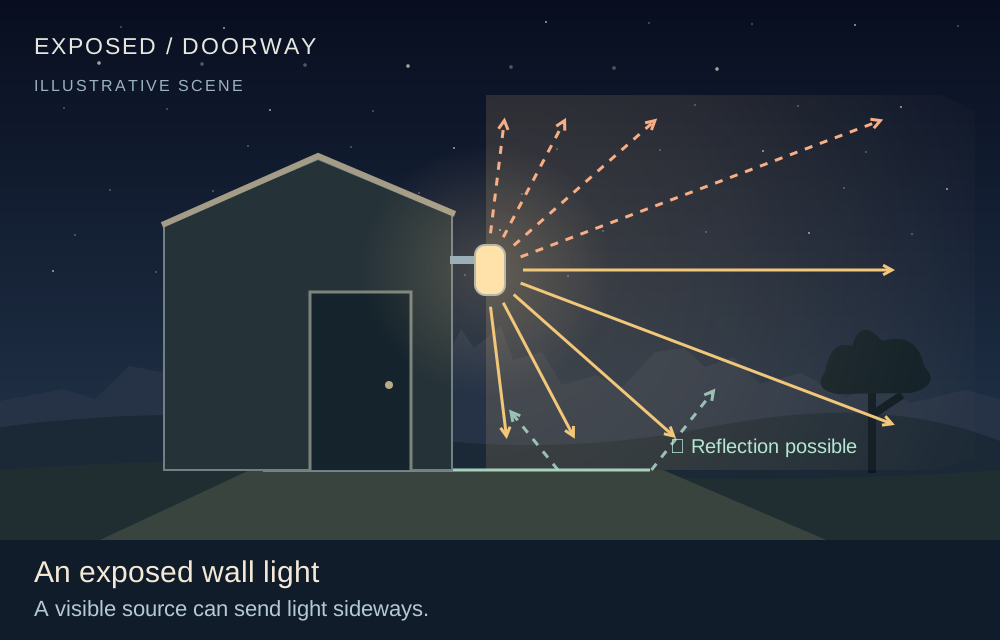 Before: light goes everywhere
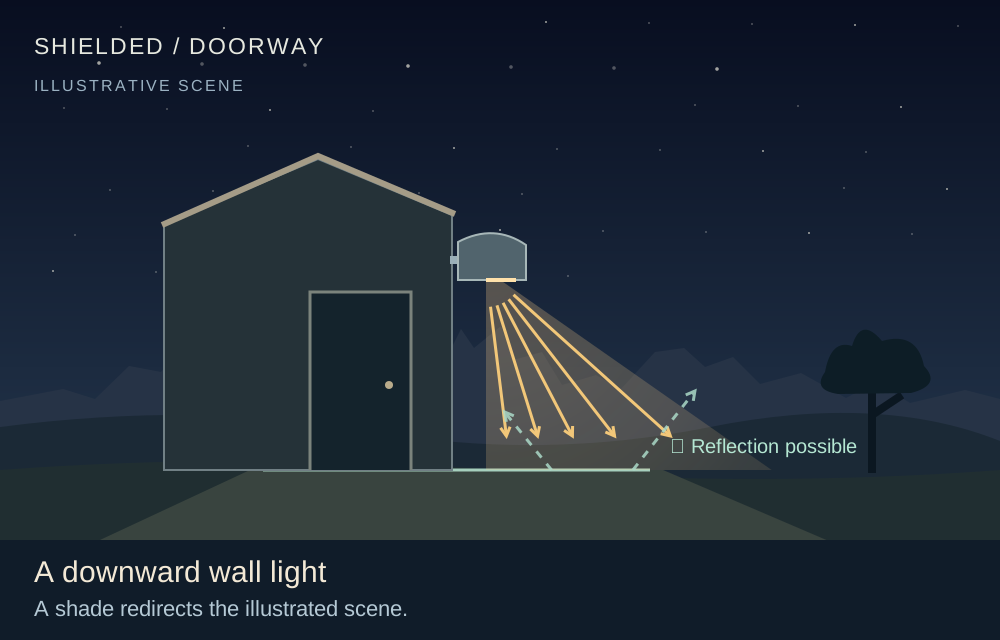 After: only where it is needed
 Illustration A wall light before and after a shade. Drawings by Bryce Canyon Conservancy after NPS lighting guidance (2025); the rays are schematic, not measured.
Planned Nothing is funded yet. Before any money moves, an independent board adopts a written grant policy and each town signs an agreement. The towns make their own rules.
Grants for fully shielded, warm or amber streetlights and lights on town buildings, put in by the power company or a licensed electrician.
Up to $200 a household (proposed) for shielded porch and yard lights, paid after a short night-time check by a trained volunteer.
Half the cost of new fixtures, up to $1,000 (proposed), where the public benefit of less glow is the point.
A count of the towns’ lights, a one-page fixture guide, and two community nights a year.
Planned Nothing is installed. The bat recordings would run in the summer before the change and the summer after.
This is the main measure. It is not code enforcement.
Activity is not the number of bats. Only large changes would show.
Not in the first year’s budget. Weather and the moon move the readings; a reading does not show which lights changed.
From 2013 to 2025 the towns stayed level within about 20%, and the satellite cannot see blue light, so only big changes would register.