
The page reads in full without it; the interactive tools load only when you ask.
FORM & FIELD NOTES · Geology study
A window
into the rock.
The Window Workshop
What looks like a hole from one angle may be a hollow from another. Turn eight rock forms, open a cutaway, and look again.
Original teaching illustrations.
Generic forms, not scans of Bryce landmarks.
Look beyond the outline.
Prefer a still view?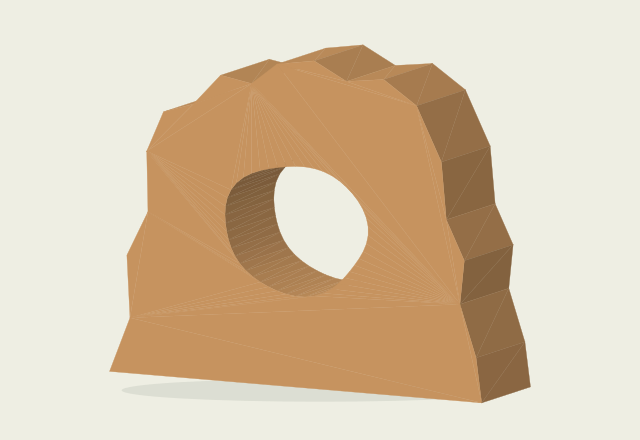
Explore the still study here, or continue through the complete illustrated reading guide.
Open the illustrated guideThe still view stays here.
Continue with the guide below.
All rock removed.
Move the slider back to reveal the form.
Window
Round window
Through openingRock encloses a passage on every side. Both faces open into the same connected void.
Peel away the front face, then look underneath the roof of the opening.
EIGHT WAYS TO LOOK
A small library of openings.
Choose a study to place it in the workshop.
A window is a hole through rock, not a painted dark patch.
THE STILL GUIDE
Read the rock. Keep the questions.
Everything here works without 3D or JavaScript.
A fin is a thin rock wall. At Bryce, weathering can open windows within fins. “Arch” and “window” overlap in everyday and geologic use; these eight studies are an informal shape library, not a formal taxonomy. NPS: Arches ↗
Rock around an opening includes a roof, side walls, and sometimes a sill. The drawing labels what remains. It does not calculate load paths or stability, and the same outline could hide very different rock conditions.

 Illustration FIG. 01 Rock and open space. Gold hatching means an artificial section; it is not a rock layer.
- 01
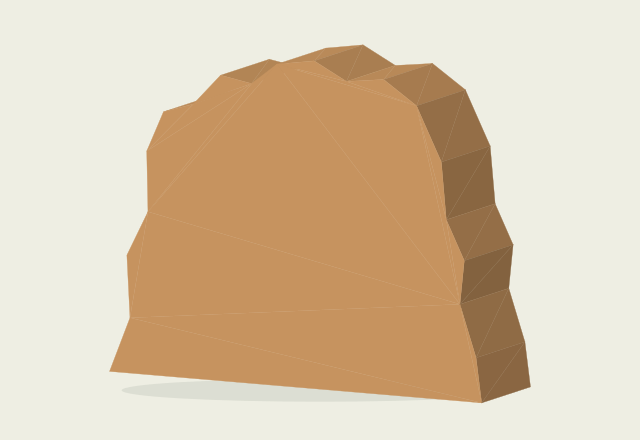
Unbroken fin
A thin wall of rock. A dark mark on its face would not, by itself, establish a hole. A silhouette cannot tell you the whole solid.
Open the unbroken fin drawing ↗ - 02
Round window
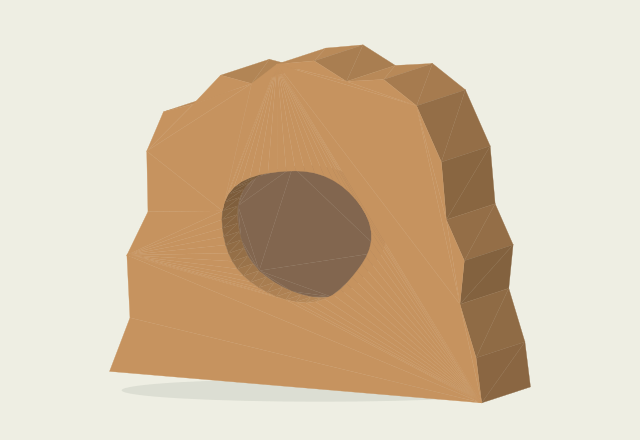
Rock encloses a passage on every side. Both faces open into the same connected void. A window is a hole through rock, not a painted dark patch.
Open the round window drawing ↗ - 03
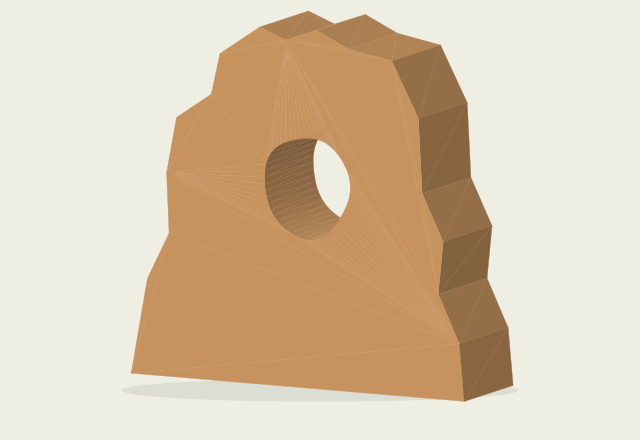
High window
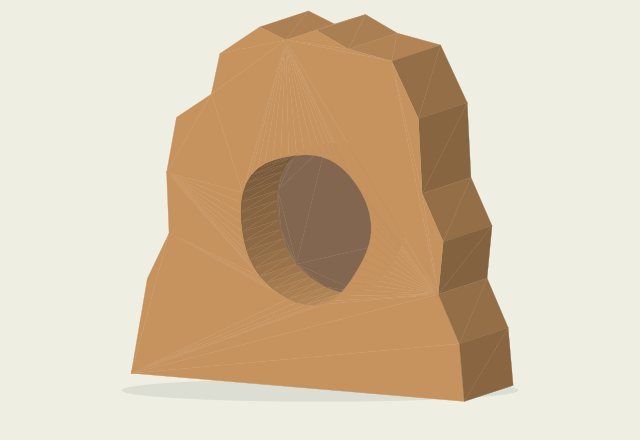
A small, high opening leaves a broad rock sill below. Its shape is an invented comparison. A section is a sample at one position, not the entire shape.
Open the high window drawing ↗ - 04
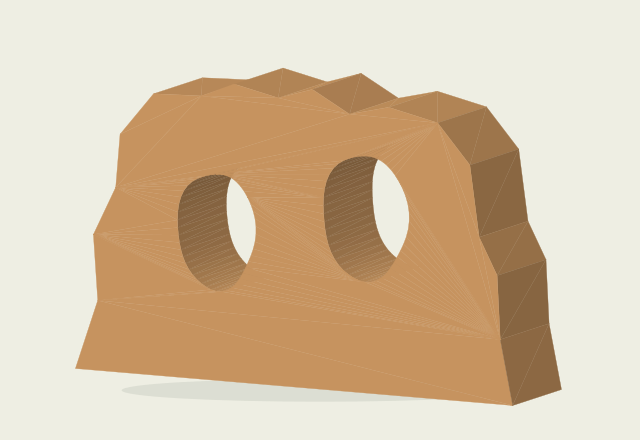
Twin windows
Two separate passages share one wall. A narrow central pier separates them. Two openings can be distinct even when their surrounding rock is connected.
Open the twin windows drawing ↗ - 05
Low arch
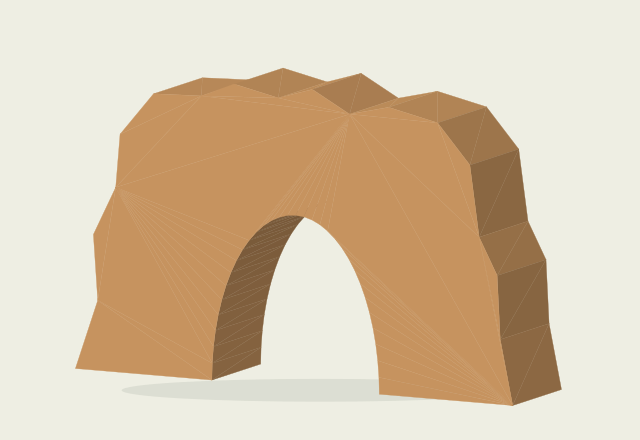
A roof joins two legs above a gap that reaches the base of the illustration. In this model the gap meets the base; this is a shape comparison, not a formal arch classification.
Open the low arch drawing ↗ - 06
Offset arch
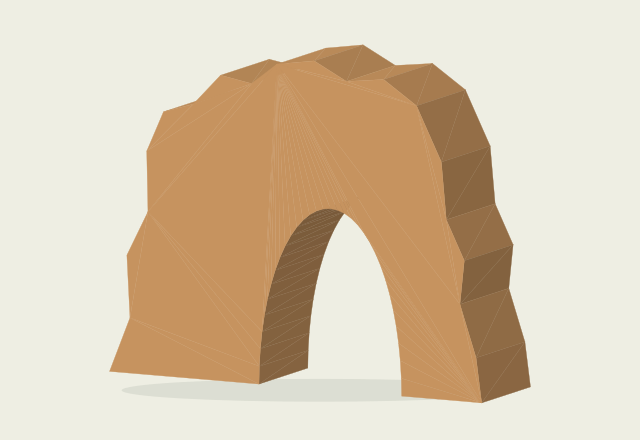
An off-center gap leaves unequal legs. The narrower leg is not a calculated failure point. Shape alone does not supply rock strength, loading, or a collapse date.
Open the offset arch drawing ↗ - 07
Shallow alcove
A pocket opens on the front face but stops within the rock. It is not a through-window. A shadowed recess and a through-hole can look similar from a single view.
Open the shallow alcove drawing ↗ - 08
Deep alcove
A deeper pocket still retains rock at the rear. Greater depth does not automatically make a window. Missing observations should remain unknown, rather than be filled with an invented passage.
Open the deep alcove drawing ↗
FOUR CUTAWAYS
Take a section. Find the difference.
Cutting exposes an invented interior. It does not reveal the inside of a real landmark.
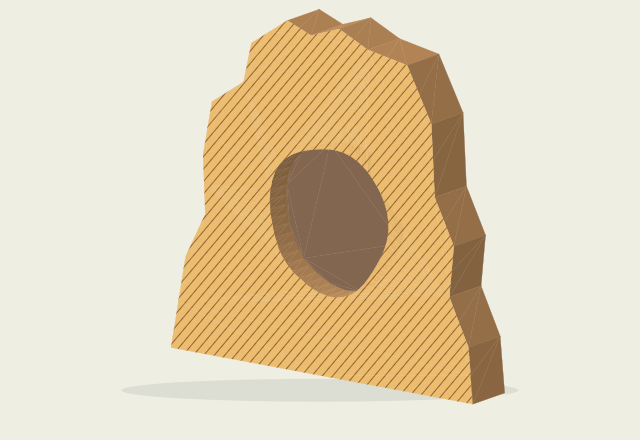 Illustration
1. Peel face
Remove rock from front to back. Gold hatching marks the new section.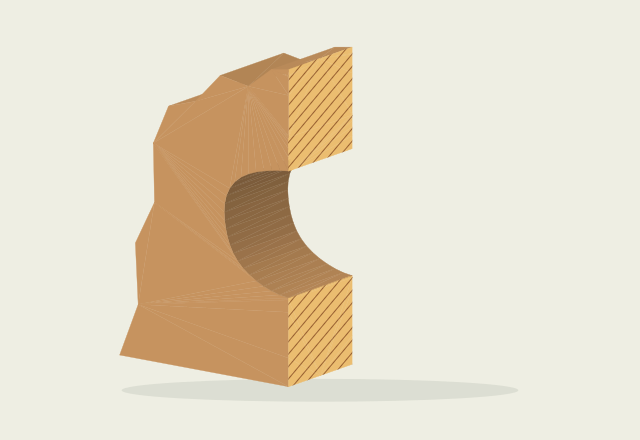 Illustration
2. Side slice
Remove rock from right to left. Watch the section meet an opening.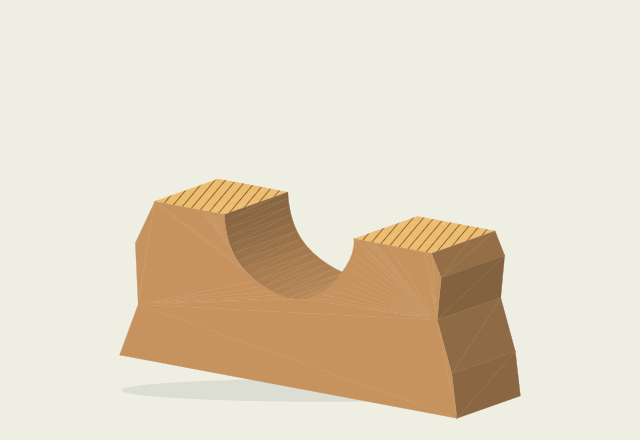 Illustration
3. Lower roof
Remove rock from top to bottom. Each level reveals a different section.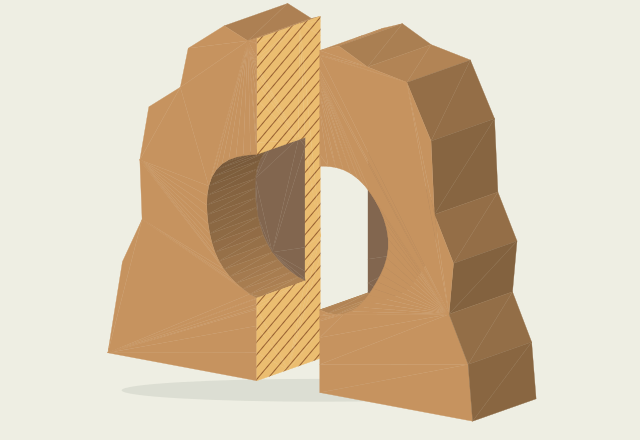 Illustration
4. Separate
Separate two capped halves at the center. The gap is an explanatory displacement.THE VIEWPOINT MATTERS
Above is not
the same as underneath.
An overhead observation can meet a roof before it reaches the underside. A ground observation may see into an opening while another surface blocks the back. A different angle adds evidence, but does not guarantee complete coverage.
Occlusion means the line of sight is blocked. USGS research describes why multiple scanner positions can reduce unsampled areas. Our drawing applies that general principle to an invented rock form; it is not a scan-coverage map. USGS: line of sight ↗
 Illustration FIG. 02 Two observation directions. No measured coverage or survey accuracy is implied.
A height grid stores an elevation for each horizontal location. It cannot store a roof and its underside at that same location as two separate surfaces. A 3D point cloud can contain more surfaces, but only where observations were obtained. This is a geometric explanation informed by the USGS DEM definition.
BACK TO BRYCE
Names tell only part of the story.
Natural Bridge is described by NPS as an arch or window despite its familiar name. NPS describes Mossy Cave as a spring-formed alcove. Their names are useful context, not templates for the solids above.
None of these studies reconstructs Natural Bridge, Tower Bridge, Mossy Cave, or Thor’s Hammer. Actual hidden surfaces require appropriate observations. A procedural illustration does not replace a ground scan.
Continue into Bryce geologyEVIDENCE & CREDITS
A clear line between a model and a place.
All eight solids, sections, colors, and proportions are original BCC teaching illustrations. Coordinates are dimensionless. No photography, survey geometry, or third-party diagram has been copied into this lab. Terminology and observation principles were checked against the primary sources below on October 2, 2026.
- Wall and Narrows ↗National Park Service, Bryce Canyon National Park · 2021-09-04
- Arches ↗National Park Service, Bryce Canyon National Park · 2015-02-24
- Natural Bridge ↗National Park Service, Bryce Canyon National Park
- Mossy Cave Trailhead Wayside ↗National Park Service, Bryce Canyon National Park · 2024-10-10
- Methodological considerations of terrestrial laser scanning for vegetation monitoring in the sagebrush steppe ↗US Geological Survey publication catalogue; Environmental Monitoring and Assessment · 2017-11-01
- Lidar Base Specification: Glossary ↗US Geological Survey
3D rendering and polygon triangulation: locally hosted Three.js, MIT license. Typography: Gelasio and Inter, SIL Open Font License. Machine-readable source and claim record · Reusable model parameters.
This local educational candidate has not received independent geologic, physical-device, or structural-engineering acceptance. It implies no NPS affiliation or endorsement.